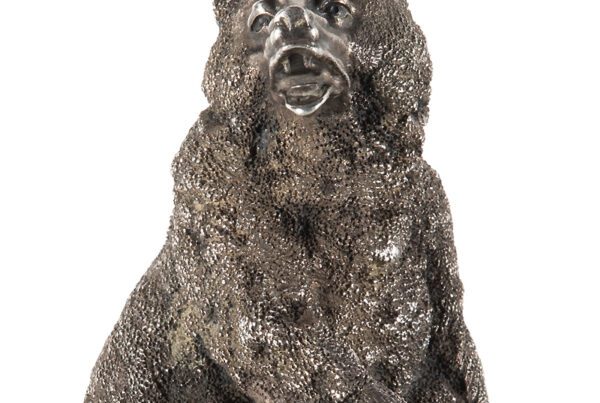

Doyle of New York held three Russian auctions on April 21/22. I’m not sure why they didn’t opt for just one strong sale, rather than three of diluted quality….
Their Russian Works of Art had a decent take-up – with 114 of the 135 lots sold – but only ten of those lots went beyond $10,000 hammer. There were loads of things you see in every sale, but hardly anything to set the pulse racing.
One of the top lots was an enamel Tea Set by Ovchinnikov with original fitted case. The price of $83,050 was respectable given the pretty simple, rather mundane design (Lot 208, est. $70,000-90,000).
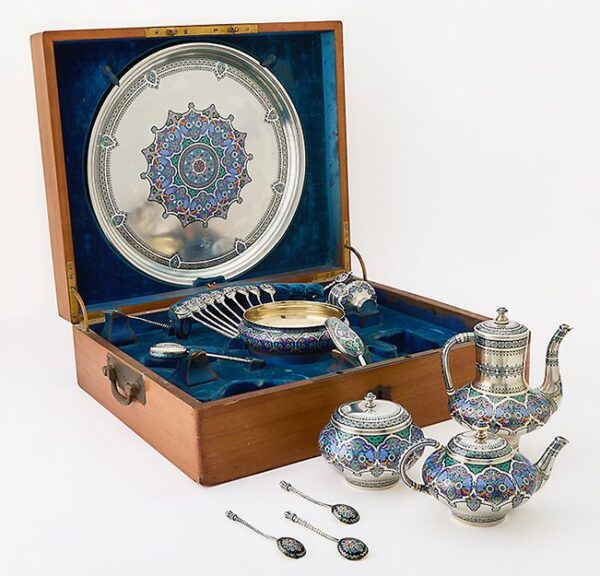 SILVER AND ENAMEL TEA AND COFFEE SERVICE, P. OVCHINNIKOV (LOT 208)
Another item of distinction was a jewelled silver-gilt and translucent blue guilloché enamel Cigarette Case by August Hollming (St Petersburg 1908-17), with a hinged cover applied with a diamond-set gold Imperial double-headed eagle and ‘diamond cabochon push-piece.’ I’ve never seen diamonds cut as cabochons. In any case, the diamond here seems to be faceted.
Doyle claim this was ‘one of three cigarette cases acquired by the Cabinet of His Imperial Majesty from Fabergé’s St Petersburg branch on 16 April 1909’ and ‘given to Nicholas II on 15 March 1910 for use as a personal gift.’ It was then swiftly ‘presented to Mr Krusenstern on 22 March 1910’ or not so swiftly ‘presented to Empress Maria Feodorovna on 8 March 1911.’ Well, which one got it? Doyle’s catalogue entry is misleading and prevaricating. First this is one of three 1909 cigarette cases, then it’s down to two – and how do Doyle’s know that anyway, given that Fabergé produced blue cigarette cases by the score?
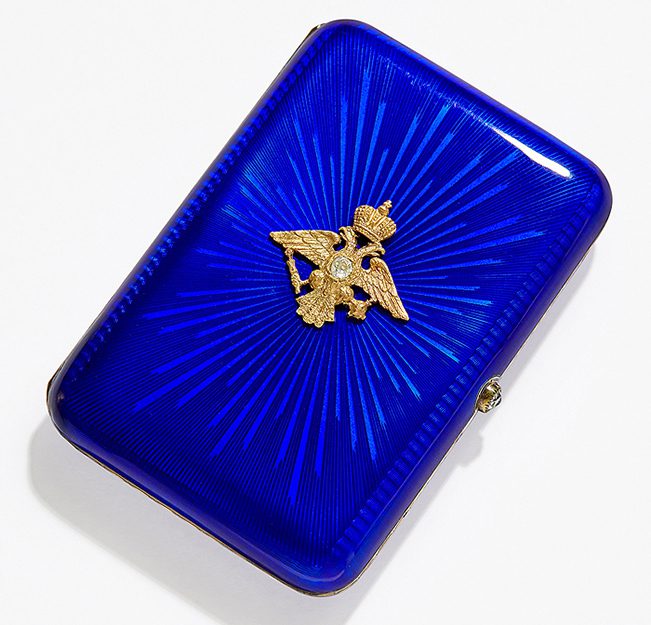 SILVER-GILT AND ENAMEL CIGARETTE CASE, FABERGÉ (LOT 233)
Be all that as it confusingly may, it’s a nice-looking case and caught my eye. My interest coolled when Doyle’s Russian expert Mark Moehrke (ex-Christie’s) told me that a significant area of enamel had been damaged and restored. Still, the piece fetched $54,400, over double the high-estimate – a very decent return (Lot 233, est. $15,000-25,000).
An oval Bread & Salt Platter (50 x 56cm) carved in the Sholtz workshop in Moscow sold for $60,800 – doubtless a world record price for bread & salt platter. It bore a Cyrillic inscription To Their Imperial Majesties Sovereign Nicholas Alexandrovich and Sovereign Alexandra Feodorovna from the Moscow Merchant Society, plus the date 26 August 1909. A nicely carved but pretty modest offering: I’d have expected the Moscow Merchants to push the boat out a bit further when trying to curry favour with the Tsar! Such prestige gifts were typically assigned to major silversmiths like Fabergé, Ovchinnikov or Khlebnikov. The Tsar must have found the Merchants awfully parsiminious, if not strapped for cash… hardly a ringing endorsement of their supposed financial acumen (Lot 238, est. $3,000-5,000).
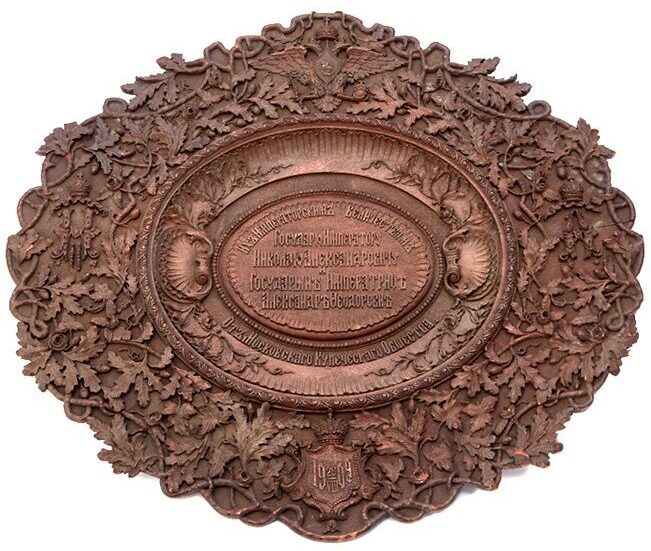 CARVED WOOD BREAD AND SALT PLATTER, K. SHOLTZ WORKSHOP (LOT 238)
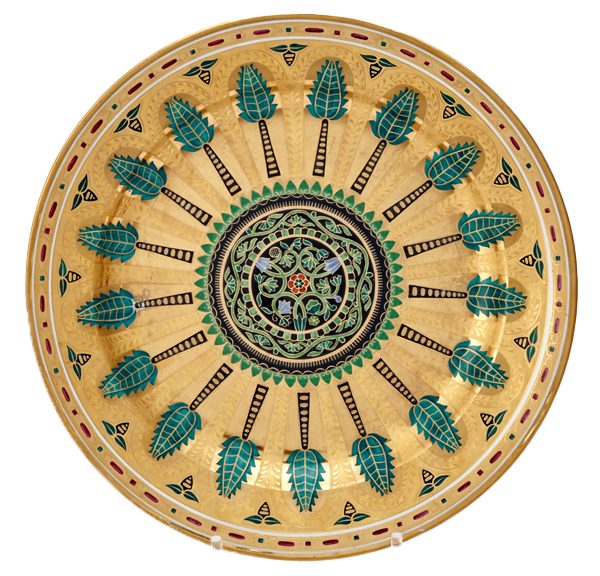
There were six items of Russian porcelain. Top price was a paltry low-estimate $2,560 for a plate from the Order of St Andrew the First-Called service. A Nicholas I Imperial Porcelain Charger from the Kremlin Service failed to reach its low-estimate of $10,000 (Lot 262, est. $10,000-15,000). Twenty years ago these large plates were selling for $50,000! It’s as if the porcelain market was torpedoed by Covid, and there are no porcelain punters left. Have they all died off? I have no idea. Look at the sale of porcelain from the stock of A La Vieille Russie at Heritage in Dallas last December. It fell as flat as a pancake.
-

- PLATE FROM THE KREMLIN SERVICE, IMPERIAL PORCELAIN MANUFACTORY (LOT 262)
-
- PLATE FROM THE ORDER OF ST. ANDREW THE FIRST-CALLED SERVICE (LOT 266)

*
A couple of pictures sold well at Doyle’s Russian Paintings. A small Portrait of a Girl with a Hay Rake ‘attributed to’ Venetsianov soared to $140,200. It did indeed look like Venetsianov – but the high price constituted a leap of faith for a work that is not signed (Venetsianov hardly ever signed anything) and came without detailed provenance (merely ascribed to ‘a West Coast Collection’). The homely country gal will have been of scant interest to Western buyers, so I imagine the work is destined for a Russian collection and will soon officially emerge in Moscow or St Petersburg as a Venetsianov, whether it actually is or not. There’s no way of being sure (Lot 2, est. $3,000-5,000).
 PORTRAIT OF A GIRL WITH A HAY RAKE, A. VENETSIANOV (LOT 2)
There was also a fine price of $152,900 for a spectacular Coucher de Soleil (‘Sunset’) by Ivan Choultsé (1874-1939). Doyle located the work in the Engadine, a region of south-east Switzerland centred on St Moritz; the setting resembles Lago Bianco on the Bernina Pass leading south towards Italy. Choultsé made several trips to the Engadine, and was strongly influenced by the great Swiss 19th century landscapist Alexandre Calame (Lot 12, est. $20,000-40,000).
 COUCHER DE SOLEIL (‘SUNSET’), I. CHOULTSÉ (LOT 12)
Choultsé was born Иван Шультце in St Petersburg in 1874, into a family of German origin (originally named Schultze). As an artist he was a late developer. He trained as an engineer, and only began to paint professionally in his thirties: Doyle’s dating of the work to ‘circa 1905’ is as fanciful as the alternative title they assign it (Twilight of the Gods), presumably on account of its blood-curdling Wagnerian sky.
Choultsé travelled in Western Europe from 1917-19, spending much of that time in the Alps. He quit Russia permanently in 1921, and spent the rest of his life mainly in France – in Paris then Nice, where he died in 1939. He was granted French citizenship in 1927; his tombstone in Nice’s Cimetière de Caucade names him Jean Choultsé. His works appear regularly in major salerooms. During his life they were exhibited in Paris, London (at Arthur Tooth & Sons in New Bond Street) and in the United States. In fact, Choultsé acquired greater fame in the West than in his native Russia, where he is considered something of a poor man’s Kuindzhi. That said, Carl Fabergé and members of the imperial family numbered among his early clients!
*
Doyle’s third Russian sale, devoted to Icons, can only be described as a flop. Okay, 29 of the 46 icons found takers – but only seven of those made it past high-estimate. The overall quality was atrocious. Those 29 lots sold for a (premium-inclusive) total of $36,936. That didn’t even match the combined total of the 46 low-estimates ($44,500)! Hardly anything sold above $2,000, with just one five-figure price: $12,600 for an 18th century Icon of the Guardian Angel (Lot 1016, est. $800-1,200).
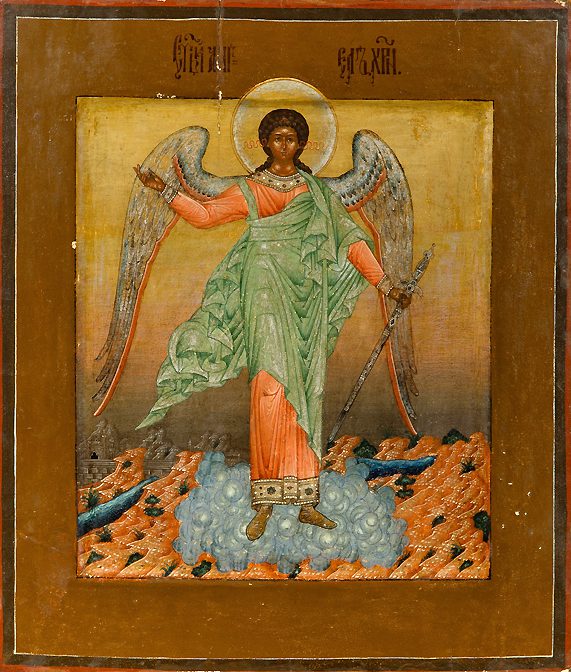 ICON OF THE GUARDIAN ANGEL (LOT 1016)
Why bother staging such a sale? Such merchandise belongs in a Brighton Beach flea-market, next to old shoes and moth-eaten garments – not in a well-known and respected auction house. It gives Russian icons a bad name. Sales like this bode ill for the market itself – and for Doyle themselves.