The Collections sale staged by Christie’s New York April 9-23 featured 29 Russian items, sixteen of them icons: a nice clean group. None were fantastic, but several yielded hefty prices.
I’m not sure why anyone would have wanted the small, not very exciting, late 15th century icon of the obscure St Leonty of Rostov: its condition appeared questionable at best, with cracked paintwork and the background scraped off. Even so, it commanded $27,940, almost double high-estimate (Lot 35, est. $10,000-15,000). Maybe the buyer was some guy called Leonty (not that I know any).
-

- ST. LEONTIY OF ROSTOV (LOT 35)

-
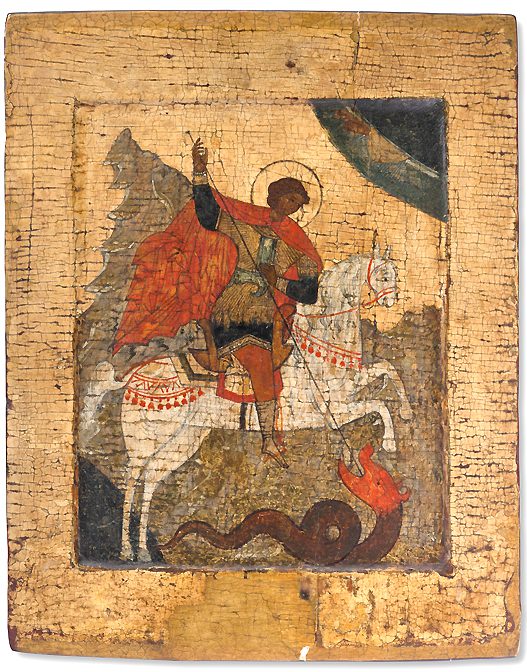
- ST GEORGE SLAYING THE DRAGON (LOT 36)
Six other icons cleared $50,000, each of them more than doubling – sometimes quadrupling – their published estimates. Three of them dated from the 16th century.
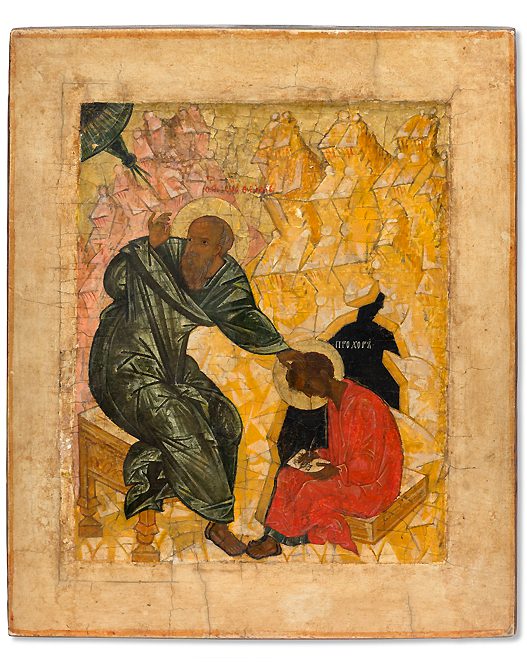
An icon of St George Slaying the Dragon, that used to be mine many years ago, sold for $57,150, almost four times estimate – a big price given its condition, but icons of St George are always popular: killing dragons never goes out of fashion (Lot 36, est. $10,000-15,000). An icon of the Old Testament Trinity (Moscow School) doubled top-estimate on $53,340 (Lot 38, est. $15,000-25,000), while another 16th century Moscow icon brought $63,500 – over four times estimate. According to the catalogue it depicted St John the Evangelist and his scribe Prochoros on the Island of Patmos, with the Saint dictating a passage from the Apocalypse. The author of this ‘Apocalypse’ (i.e. the Bible’s Book of Revelation) identifies himself as ‘John’ and is generally referred to as ‘St John The Divine’ – not The Evangelist; stylistic differences between St John’s Gospel and the Book of Revelation argue against the two Johns being one and the same (Lot 37, est. $10,000-15,000).
-
- THE OLD TESTAMENT TRINITY (LOT 38)

-
- JOHN THE EVANGELIST AND PROHOROS ON PATMOS (LOT 37)
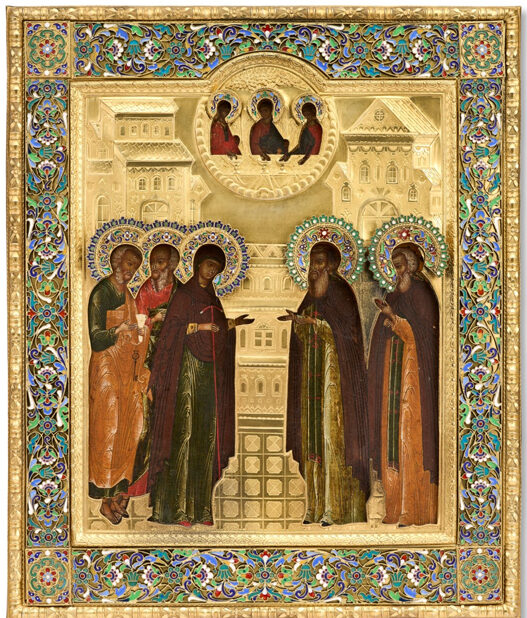
Interest from icon collectors is not waning but unwavering – especially if silver, pearls, filigree and enamel are involved. Take the cloisonné enamel and silver-gilt icon of the Apparition of the Mother of God to St Sergius with the mark of Yakov Mishukov (Moscow, c.1890): it span to $82,550, five times estimate. I own an icon with the same subject, and I’ve seen a few others – all being 17th century icons covered with 19th century oklads. I’m almost certain that’s the case here, which Christie’s failed to mention (Lot 30, est. $10,000-15,000).
-
- APPARITION OF THE MOTHER OF GOD TO ST.SERGIUS (LOT 30)
-
- THE MOTHER OF GOD OF VLADIMIR (LOT 31)
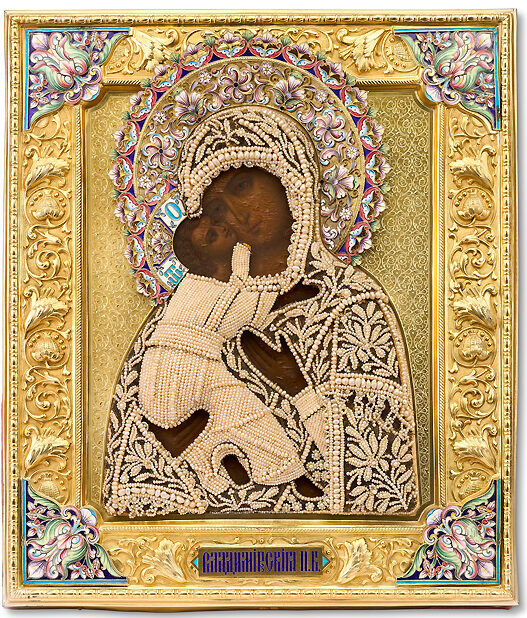
A very attractive cloisonné and champlevé enamel and silver-gilt icon of the Virgin of Vladimir, with seed-pearl vestments and the mark of Ivan Alexeyev (Moscow 1899-1908), swept even higher – to $88,900, more than three times top-estimate (Lot 31, est. $15,000-25,000).
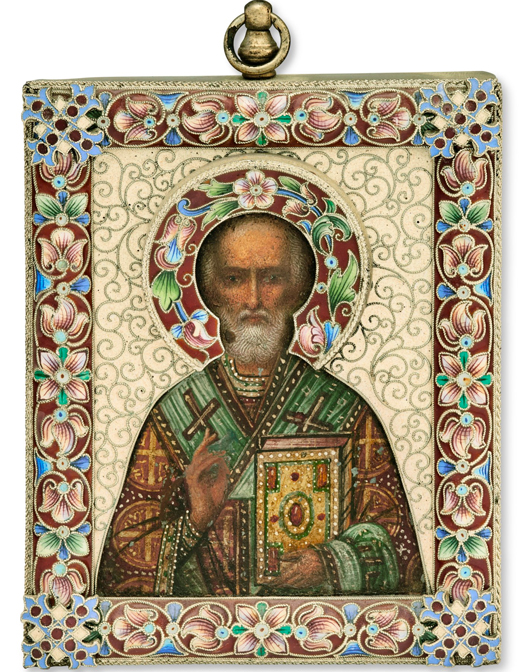
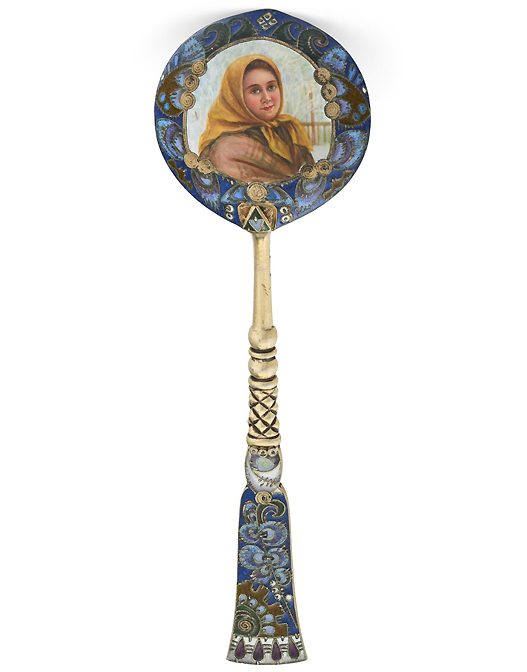
The same price – against an identical estimate – greeted a small, powerful, cloisonné enamel and silver-gilt Rückert icon of St Nicholas (lot 27, est. $15,000-25,000). Collectors can never get enough Rückert! His pieces with miniatures almost always zoom past high-estimate: take the cloisonné enamel silver-gilt spoon with en plein portrait of a young woman in a headscarf (based on Fedor Sychkov’s portrait Akulka) that made $27,940 later in the sale (Lot 48, est. $6,000-8,000).
-
- ST. NICHOLAS, F. RÜCKERT(LOT 27)
-
- CLOISONNÉ AND EN PLEIN ENAMEL SILVER-GILT SPOON, F. RÜCKERT (LOT 48)
The spoon was among a dozen Russian Works of Art at Christie’s, including an Imperial Porcelain Easter Egg depicting St George and his Dragon that almost doubled top-estimate with $8,255 (Lot 44, est. $3,000-5,000).
-
- PORCELAIN EASTER EGG (LOT 44)

-
- JEWELED GOLD AND ENAMEL CIGARETTE CASE, LORIE (LOT 50)

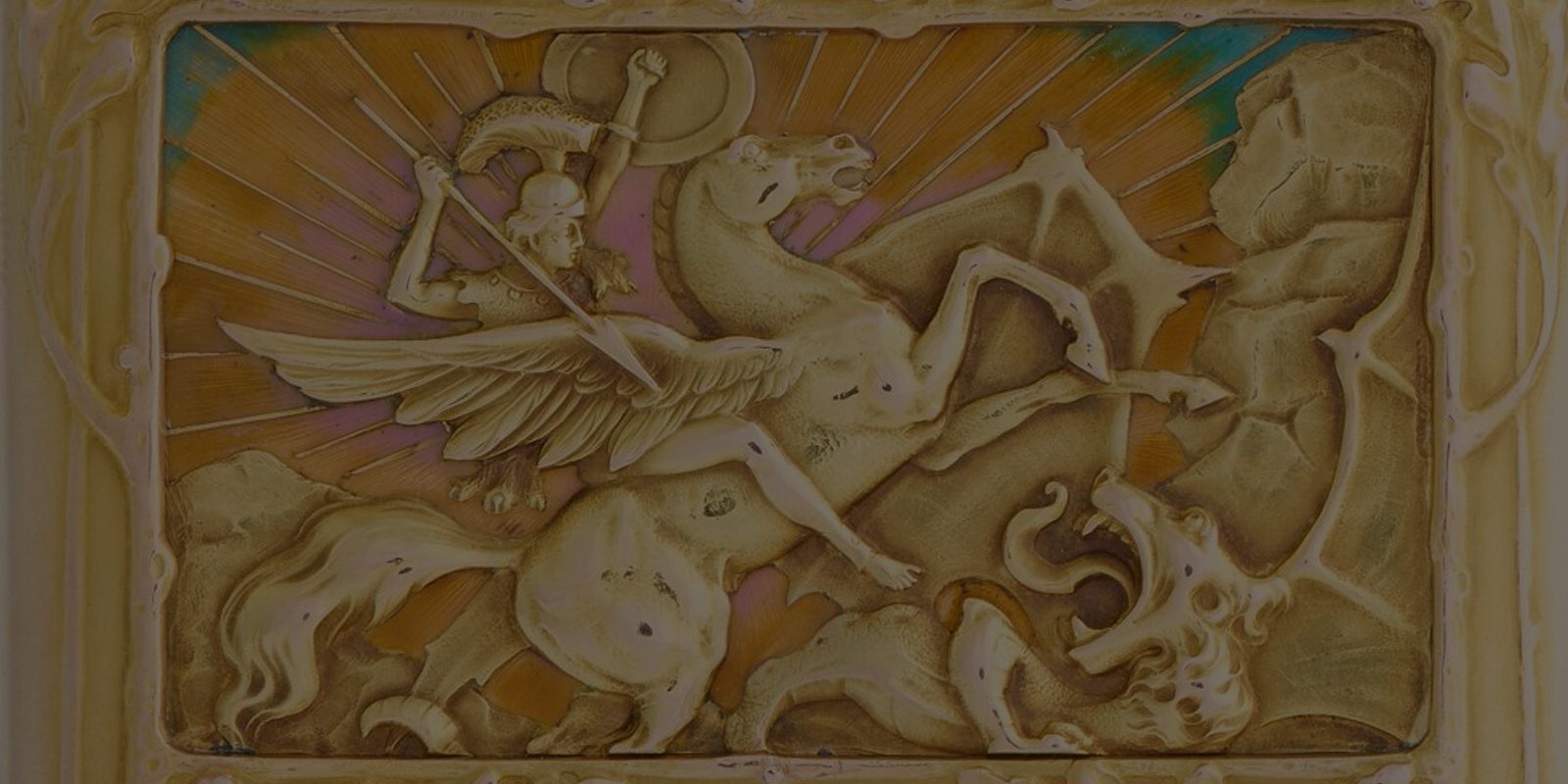
The saint and the hapless fire-breathing beast also featured on an alluring gold cigarette-case by Lorie of Moscow (workmaster Egor Cheryatov, 1899-1908) with cabochon sapphire push-piece and the word Любикъ spelt out in tiny diamonds. Christie’s claimed Lyubik was a Russian name, but I’ve never heard of it – and Russian’s my native tongue! All I can think of is that it may be a derivative of the girl’s name Lyuba (like my first wife’s), although the term of endearment is usually Lyubasha or Lyubochka. It sold for $25,400 (Lot 50, est. $25,000-30,000).
A large rectangular Desk Clock with two-colour scarlet and white enamel by Ivan Britsyn, almost 20cm tall, failed to sell. Britsyn produced many good-quality guilloché enamels and was one of Fabergé’s (lesser) competitors; his works appear at auction quite often. If this handsome clock had been by Fabergé it would have easily surpassed $100,000 (Lot 46, est. $30,000-40,000).
-
- ENAMEL SILVER-MOUNTED DESK CLOCK, I. BRITSYN (LOT 46)

-
- PORCELAIN AND GILT BRONZE CANDELABRUM (LOT 52)
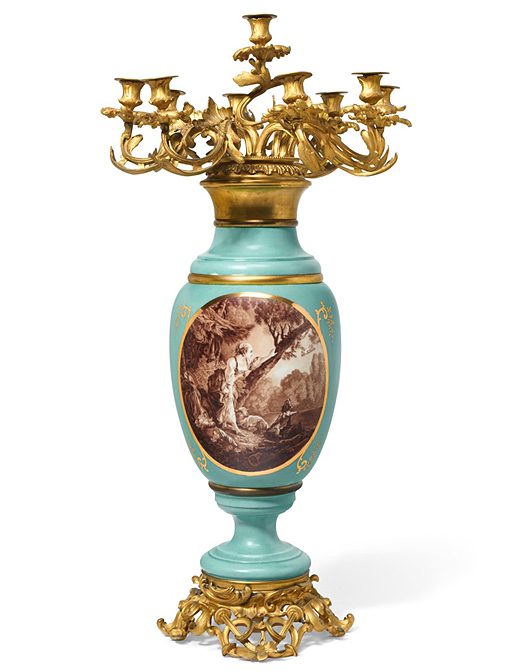
A large Alexander II turquoise porcelain vase, standing nearly a metre tall and incorporating a nine-light gilt-bronze candelabrum, was also bought in. Twenty years ago this would have soared way past its $15,000 high-estimate. It’s not particularly attractive, so no wonder it failed to find a buyer – but at $10,000 (the reserve) I still think it would have been a decent buy. Who knows why it didn’t sell? Porcelain may be somewhat out of fashion these days, but I can well imagine some savvy dealer making a post-sale offer for this piece and subsequently making a tidy profit (Lot 52, est. $10,000-15,000).