Sotheby’s Geneva are offering 34 lots by Fabergé in their 128-lot on-line sale of Fabergé, Gold Boxes & Vertu running April 28-May 15.
CLOCKS
A canary-yellow guilloché enamel Demi-Lune Desk Clock by Mikhail Perkhin (c.1890), 17.6cm, is the pick of the sale’s clocks. It is applied with a silver-gilt trellis set with seed-pearl quatrefoils and chased silver-gilt and crimson enamel roses, while the bezel is also set with seed pearls and the outer border adorned with a band of chased laurel leaves with corner rosettes (Lot 1014). This clock was sold at Christie’s London in November 2019 for £118,750 (Lot 253). Back then the pound was worth CHF1.29, meaning the clock cost the equivalent of CHF152,700. The pound has since slumped to CHF1.06, reducing the value of that 2019 investment to CHF125,900. Even so, the consignor seems prepeared to take a hit: Sotheby’s Geneva estimate reads just CHF80,000-120,000.
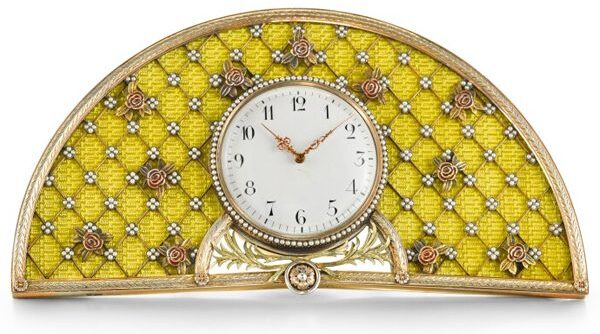 FABERGÉ PEARL-SET SILVER-GILT AND ENAMEL DESK CLOCK, M. PERKHIN (LOT 1014)
A square silver and guilloché enamel Desk Clock by Wigström (1904-08), 10.3cm tall and once owned by Grand Duchess Xenia, has translucent pink enamel over wavy engine-turning within chased silver leaftip borders, the bezel again framed by seed pearls (Lot 1010, est. CHF55,000-75,000)
-

- FABERGÉ DESK CLOCK, H.WIGSTRÖM (LOT 1010)

-
- FABERGÉ DESK CLOCK, H.WIGSTRÖM (LOT 1020)
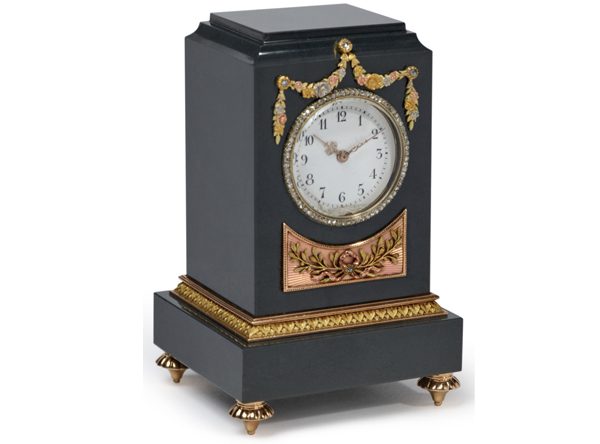
A chunky Kalgan Jasper Desk Clock by Wigström (1904), 8.5cm tall with a yellow and pink gold acanthus-leaf border, has a bezel set with rose-cut diamonds and a white opaque enamel dial with Arabic chapters and gold open scrollwork hands, surmounted by floral swags in yellow, pink and green gold. The pink guilloché enamel plaque underneath the dial is applied with a gold mistletoe branches tied with a rose-gold ribbon. This nice little clock was shown to me a while ago, but has some serious condition issues: the dial is chipped and cracked, which I fear will deter many potential buyers (Lot 1020, est. CHF30,000-50,000).
FRAMES
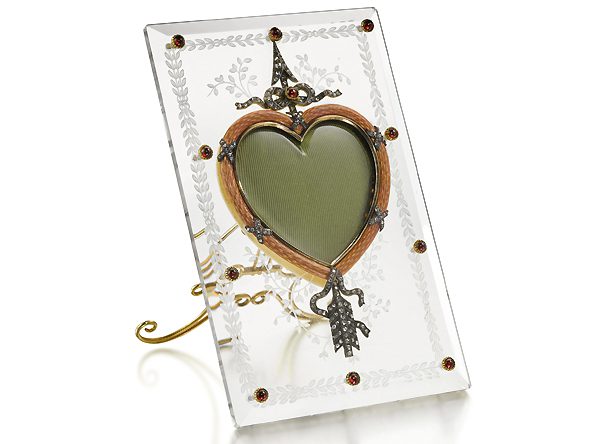
There’s a rare and wonderful rectangular rock crystal Frame by Perkhin (1899-1903), 10.4cm long, in its original holly wood case. It has a rock-crystal surface etched with laurel wreathes, and incorporates a heart-shaped pink enamel bezel mounted with rose-cut diamond ribbons and decorated above and below with a diamond-set arrow, tied with a ribbon centred with a cabochon ruby. Fabergé rarely used rock-crystal as the body of a frame or clock; chief workmaster Franz Birbaum noted how ‘rock crystal could not tolerate the slightest heat, and the settings were never soldered but assembled with clips and in other ways.’ The clock was part of the ‘Di Portanova Collection’ sold by Christie’s New York on 25 October 2000, when it fetched $143,500 (Lot 1008, est. CHF100,000-150,000).
-
- FABERGÉ ROCK CRYSTAL DESK CLOCK, M.PERKHIN (RUZHNIKOV COLLECTION)
-
- FABERGÉ ROCK CRYSTAL FRAME, M.PERKHIN (LOT 1008)
-
- FABERGÉ ROCK CRYSTAL CLOCK, M.PERKHIN (BRITISH ROYAL COLLECTION)
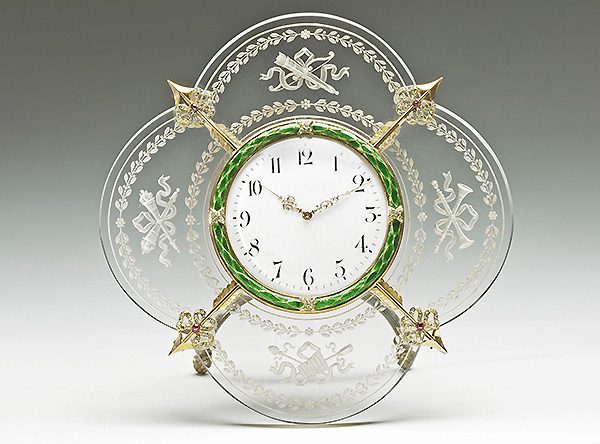
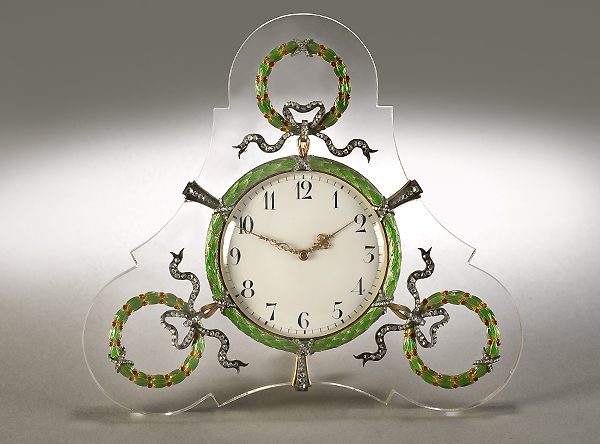
The nearest comparable design to this frame is a lobed desk clock in the Royal Collection (also by Perkhin), featuring similar diamond-set enamelled bezel and arrow motifs. I also own a very interesting rock-crystal enamel clock by Perkhin (formerly in the Forbes Collection) with an unusual trefoil shape and circular green-enamelled gold bezel flanked by three laurel-wreaths with diamond-set ribbons.
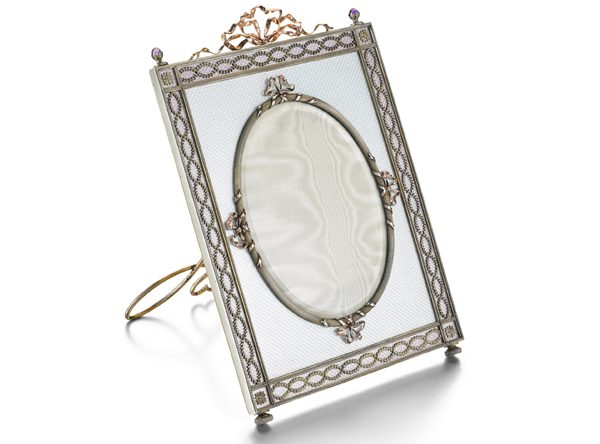 FABERGÉ GEM-SET GOLD, SILVER-GILT AND ENAMEL FRAME (LOT 1004)
A gem-set gold, silver-gilt and guilloché enamel rectangular Frame (Moscow 1899-1908), 20.7cm tall, has a translucent powder-blue enamel surface within a raised bead frame. The reeded silver bezel is encircled by a gold ribbon; the outer borders in translucent lilac enamel are applied with intertwined silver-gilt laurel leaves, with a four-petalled flower in each corner. The frame is topped by a large gold bow and flanked by cabochon amethysts on chased acanthus leaf mounts (Lot 1004, est. CHF30,000-50,000).
ANIMALS
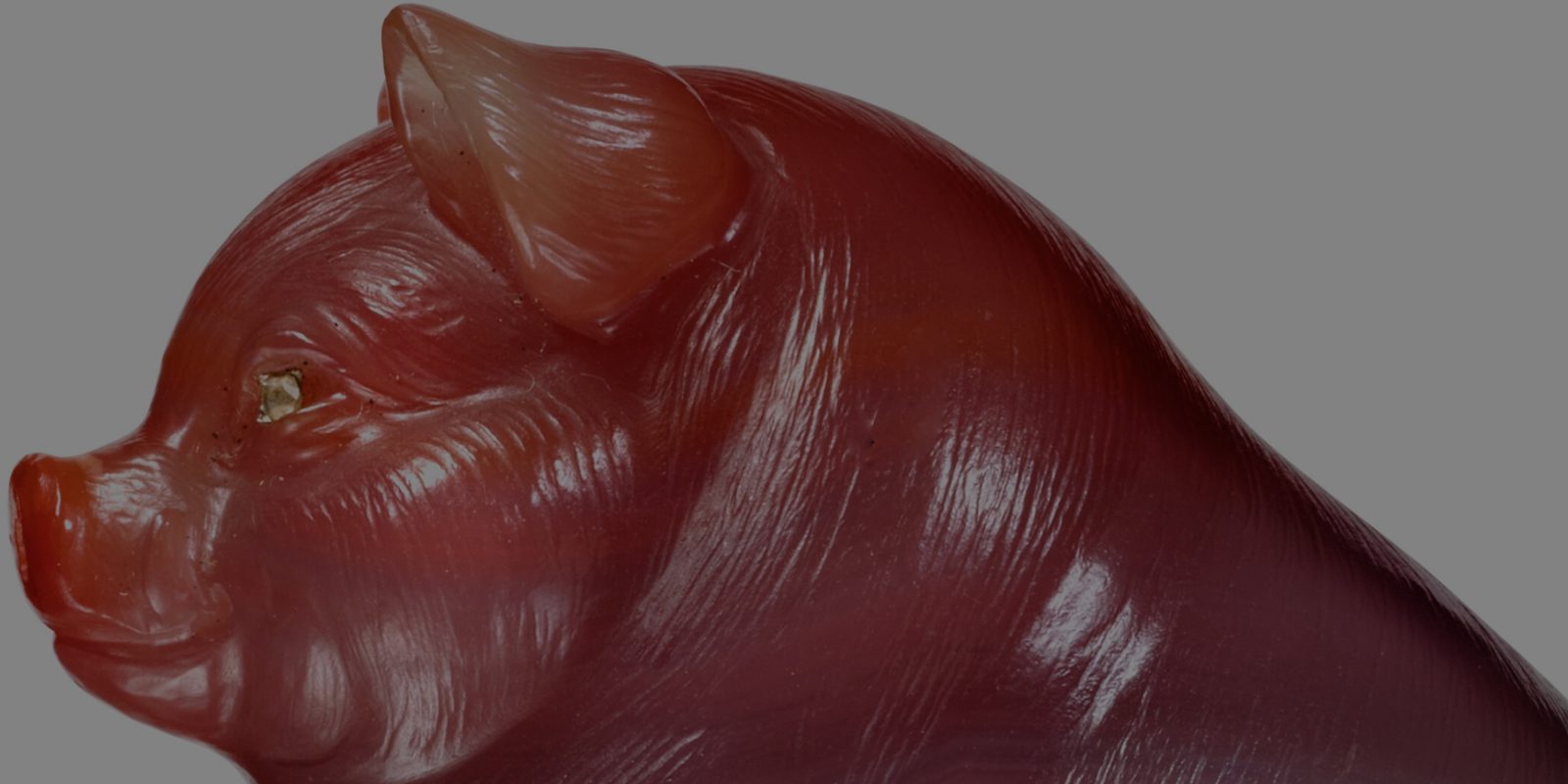
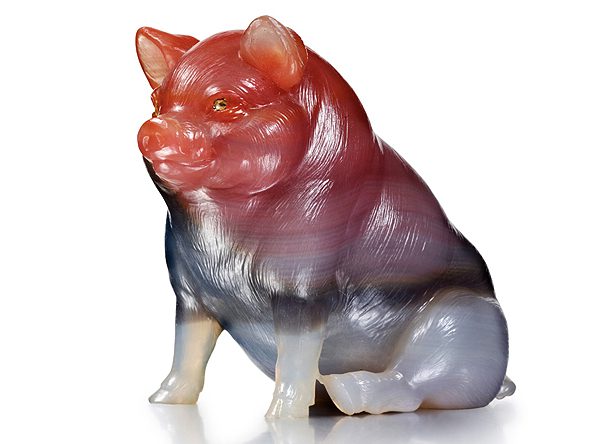
Sotheby’s animal highlight is an ‘apparently unmarked’ agate Pig, 5.3cm long with diamond eyes, in its original fitted holly wood case (St Petersburg c.1900). The agate graduates in attractive belted fashion from grey to deep red. I love the amazing choice of stone: that’s what really makes this piece (Lot 1001, est. CHF40,000-60,000).
-
- FABERGÉ MODEL OF A PIG (LOT 1001)
-
- FABERGÉ MODEL OF A SOW (LOT 1002)

Another ‘apparently unmarked’ pale green Pig in bowenite (St Petersburg, c.1900) also comes with its original holly wood case. We’ve seen lots of docile-looking Fabergé pigs like this one; they’re nothing to write home about. I don’t care much for bowenite, either. It looks like soap. I’ve never understood why Fabergé liked using boring bowenite given all the other types of stone to be found in Mother Nature (Lot 1002, est. CHF40,000-60,000).
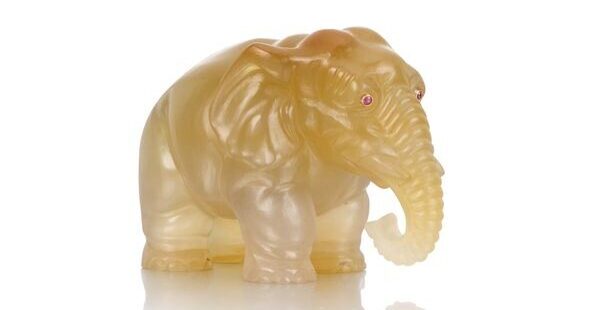
How can a nicely carved agate Elephant (c.1900) be ‘attributed to’ Fabergé when it comes without its original box or documented provenance? Sotheby’s talk airily of its being owned – ‘by repute’ and ‘oral testimony’ – by a Georgian noble family ‘for over a century.’ Oral testimony proves nothing! How do we know it’s by Fabergé rather than Sumin, Bok or Denisov-Uralsky? The Elephant was offered to me by a Georgian lady for £30,000 a few months ago. When I asked ‘Why £30,000?’ she told me her son had just been accepted at a private school where the fees were £30,000 a year (Lot 1034, est. CHF20,000-30,000).
Which reminds me. Many years ago in Buenos Aires, while I was working with the Aurora Fine Art Investment Fund, another lady collector showed me a superb Fabergé imperial gold snuff-box worth a substantial six-figure sum. Would she like to sell it? Maybe: what did I think it was worth? $700,000-800,000. She said we had a deal if I offered $6 million. I was left gasping for air! Turned out she needed $6 millon to buy a huge chunk of land for her grandchildren to inherit. They didn’t really need a Fabergé box, she explained.
-
- MODEL OF AN ELEPHANT (LOT 1034)
-
- MODEL OF A RHINOCEROS (LOT 1035)
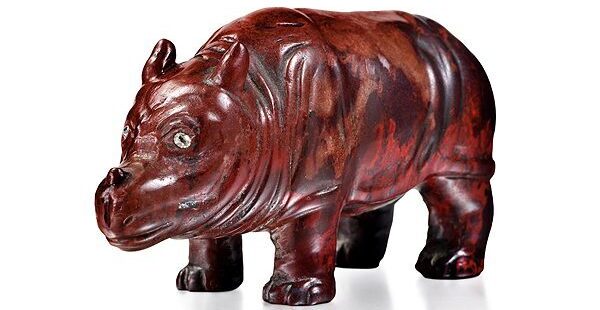
Back to Sotheby’s Geneva sale. Their ‘apparently unmarked’ Rhinoceros (St Petersburg c.1900) carved from dark red jasper has me baffled. Whatever happend to its Nose? It seems to have gone missing, maybe hijacked by Gogol. True, there’s a vague hint of stunted horn – but that’s even more worrying. Maybe it was broken off, then somehow polished and restored. The horn looks way too small for an adult rhino (Lot 1035, est. CHF12,000-18,000).
-
- FABERGÉ SILVER CHIMPANZEE TABLE-LIGHTER, J.RAPPAPORT (LOT 1036)
-
- FABERGÉ SILVER CHIMPANZEE TABLE-LIGHTER, J.RAPPAPORT (RUZHNIKOV COLLECTION)
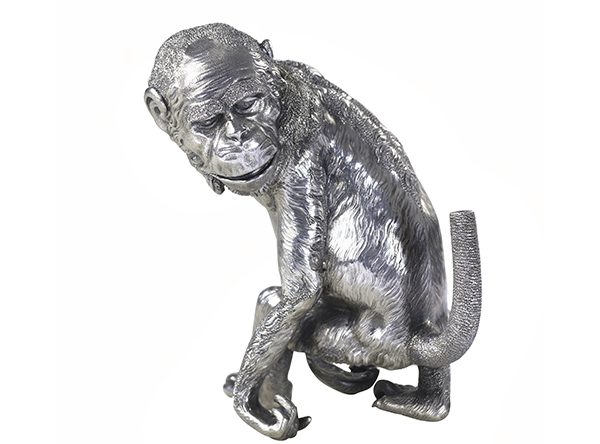
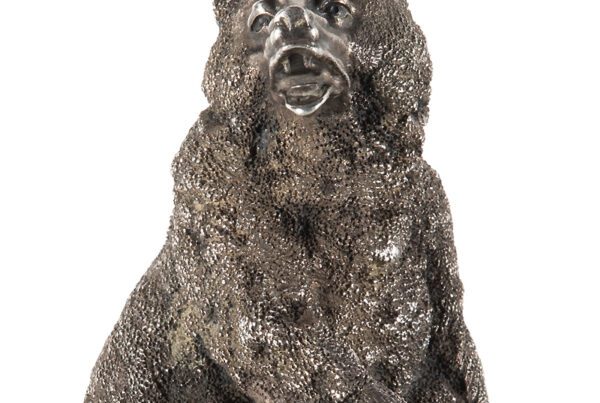
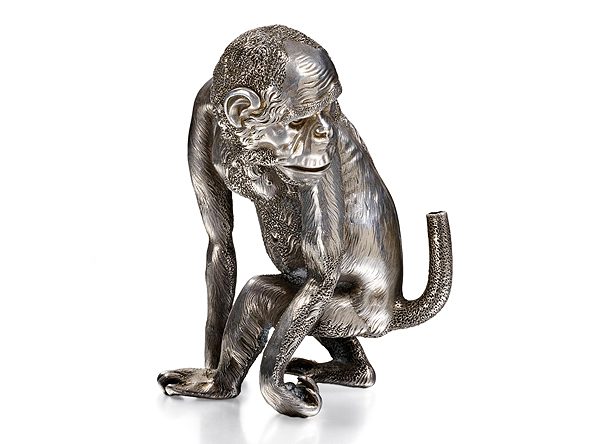
Sotheby’s are also offering a silver Chimpanzee table-lighter (1899-1903) by Julius Rappoport (Lot 1036, est. CHF30,000-50,000). I have one just like it. I don’t question the veracity of either, but wonder just how many of these monkey-lighters were produced? Apparently Rappaport produced a series of them, but I doubt we’ll ever know for sure.
MISCELLANEOUS
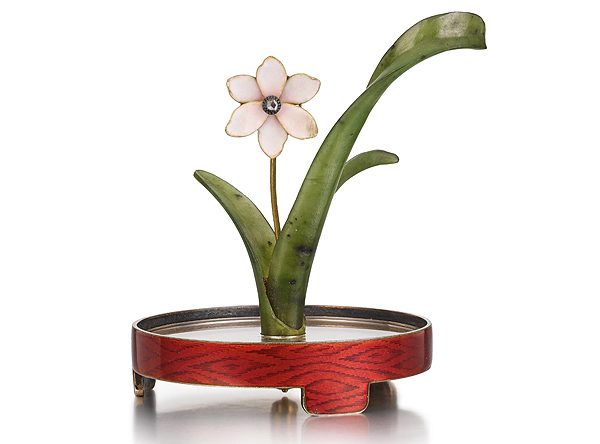
FABERGÉ MODEL OF AN ANEMONE, H. WIGSTRÖM (LOT 1003)
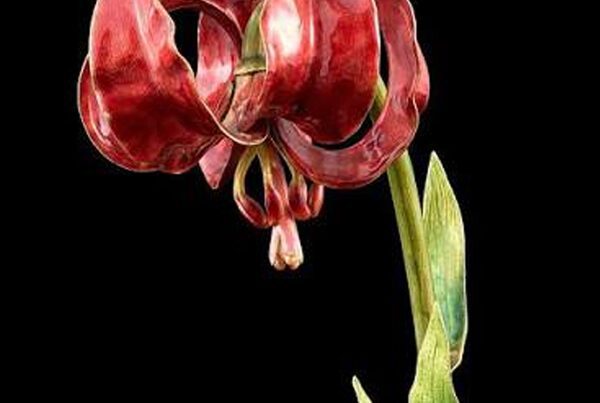
A small gold, silver, nephrite and enamel Anemone by Henrik Wigström (1908-17), 6.8cm tall on a circular silver base covered in translucent red enamel, with a glass panel simulating water. A gold stem with three carved nephrite leaves terminates in blossom of powder-pink and white enamelled petals around a rose-cut diamond-set pistil. This is a rare item. I can’t recall ever seeing such a composition (Lot 1003, est. CHF60,000-70,000).
-
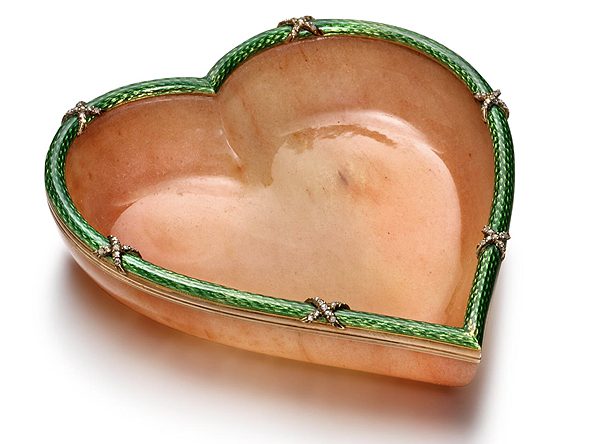
- FABERGÉ JEWELLED GOLD AND ENAMEL-MOUNTED AVENTURINE QUARTZ BOWL, M.PERKHIN (LOT 1006)
-
- FABERGÉ JEWELLED GOLD-MOUNTED NEPHRITE BOWL, H.WIGSTRÖM (RUZHNIKOV COLLECTION)
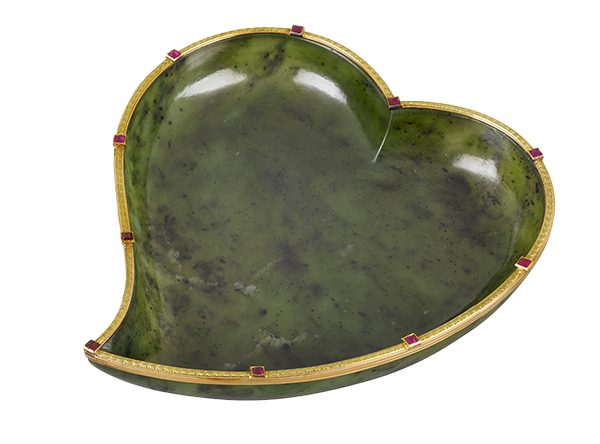
A heart-shaped aventurine quartz Bowl by Perkhin (c.1890), 8.3cm long with a gold and emerald-green enamel rim, comes with its original fitted holly wood case (Lot 1006, est. CHF30,000-50,000). I own a nephrite tray by Wigström with a not dissimilar heart shape; its gold rim is studded with tiny rubies.
-
- FABERGÉ JEWELLED GOLD-MOUNTED NEPHRITE BOX, H. WIGSTRÖM (LOT 1005)
-
- FABERGÉ GOLD-MOUNTED NEPHRITE KOVSH (LOT 1024)
-
- FABERGÉ JEWELLED GOLD-MOUNTED NEPHRITE CIGARETTE CASE (LOT 1022)
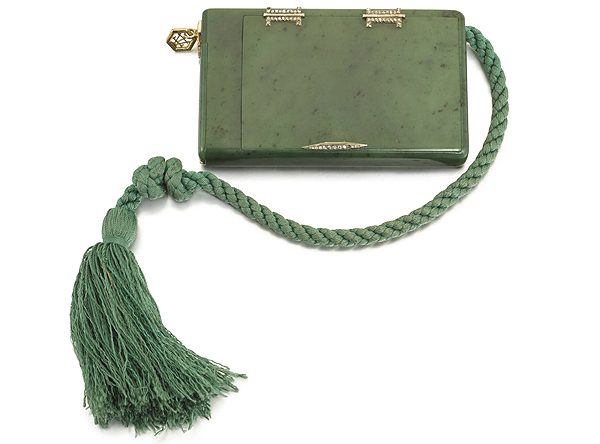
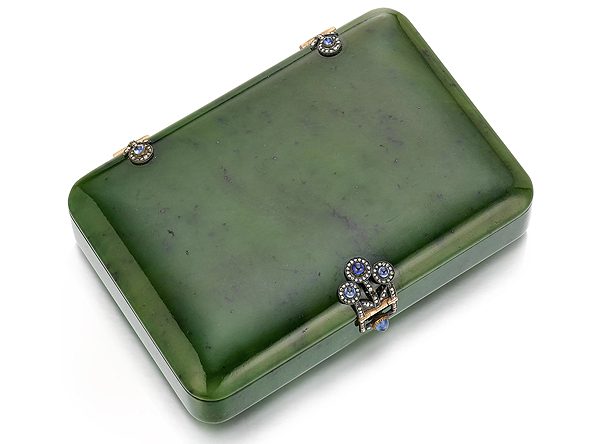
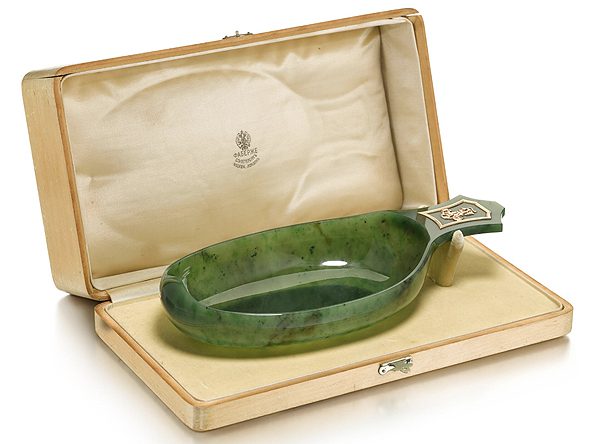
Sotheby’s sale has several pieces made from nephrite, starting with a Kovsh (St Petersburg c.1900), 21.6cm long, bearing the gold initials of its commissioner, Joseph Radine (Lot 1024, est. CHF40,000-60,000). A Wigström nephrite Box (c. 1900), 9.8cm long, has a clasp set with a cluster of three diamond-set rosettes each centred by a cabochon sapphire, with a larger sapphire underneath, and comes with a Wartski case (Lot 1005, est. CHF30,000-50,000). A nephrite Cigarette Case marked Fabergé (St Petersburg c.1900), 10.8cm long, is decorated with gold and rose-cut diamond-set hinges and thumbpiece (Lot 1022, est. CHF30,000-50,000).
-
- FABERGÉ GOLD CIGAR CASE, H.WIGSTRÖM (LOT 1021)
-
- FABERGÉ JEWELLED TWO-COLOUR GOLD CIGAR CASE, H.WIGSTRÖM (RUZHNIKOV COLLECTION)
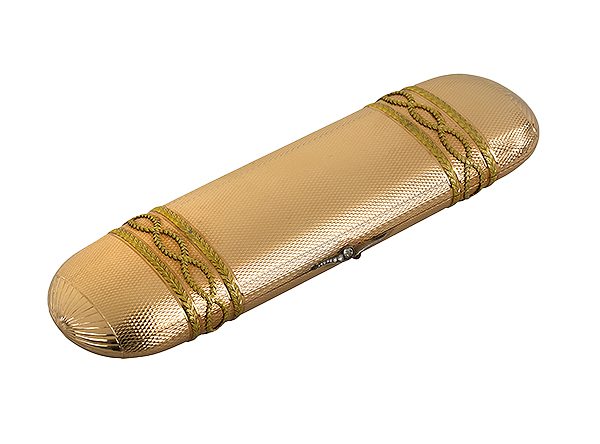
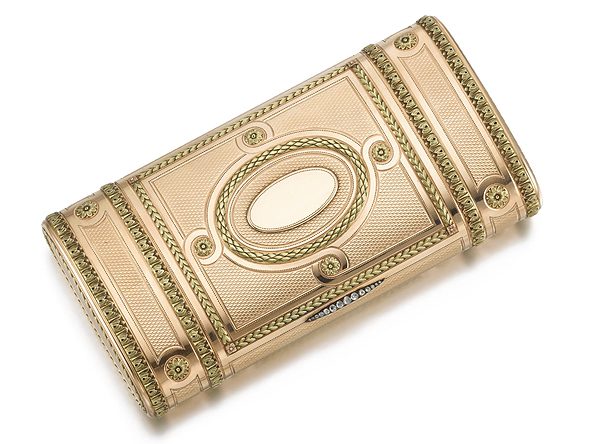
A two-colour gold Cigar Case by Wigström (1904-08), 13.3cm long, has a rose-gold surface with a central oval reserve on an engine-turned ground within chased yellow-gold acanthus wreaths, further adorned with chased gold rosettes and laurel- and acanthus-leaf borders. I love Wigstöm’s gold cigarette cases – they’re so meticulously made. The precision is mind-boggling (Lot 1021, est. CHF60,000-70,000).
-
- FABERGÉ GOLD SIGNATURE CIGARETTE CASE (LOT 1017)
FABERGÉ JEWELLED GOLD AND ENAMEL CIGARETTE CASE (LOT 1017)
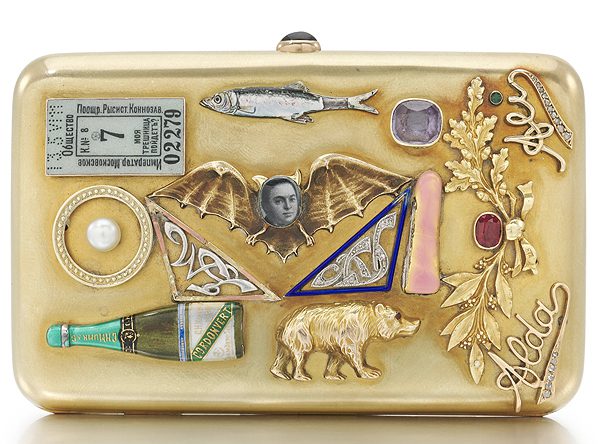
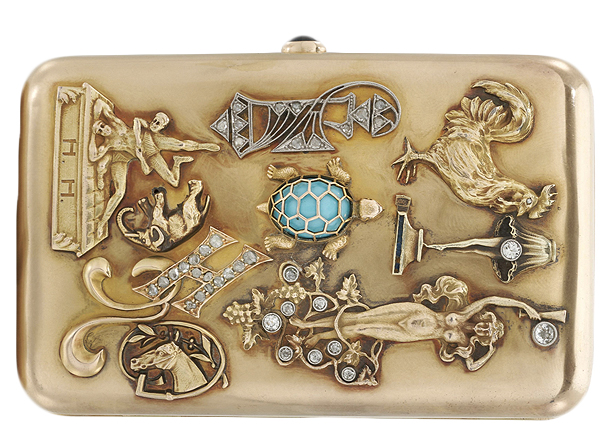
Less traditional is a gold Cigarette Case marked K. Fabergé (Moscow 1908-17), its lid inscribed Alda and Ali and whimsically cluttered with applied jewelled and enamelled charms – ranging from a fish, bear and bat with a human face to a champagne bottle and horseracing ticket. Further ‘charms’ embellish the reverse. I somehow doubt Carl Fabergé masterminded this piece himself; afterall, he was a Man of Taste. I suspect all the charms were slapped on later by Alda, Ali, or one of their friends and relations (Lot 1017, est. CHF20,000-30,000).