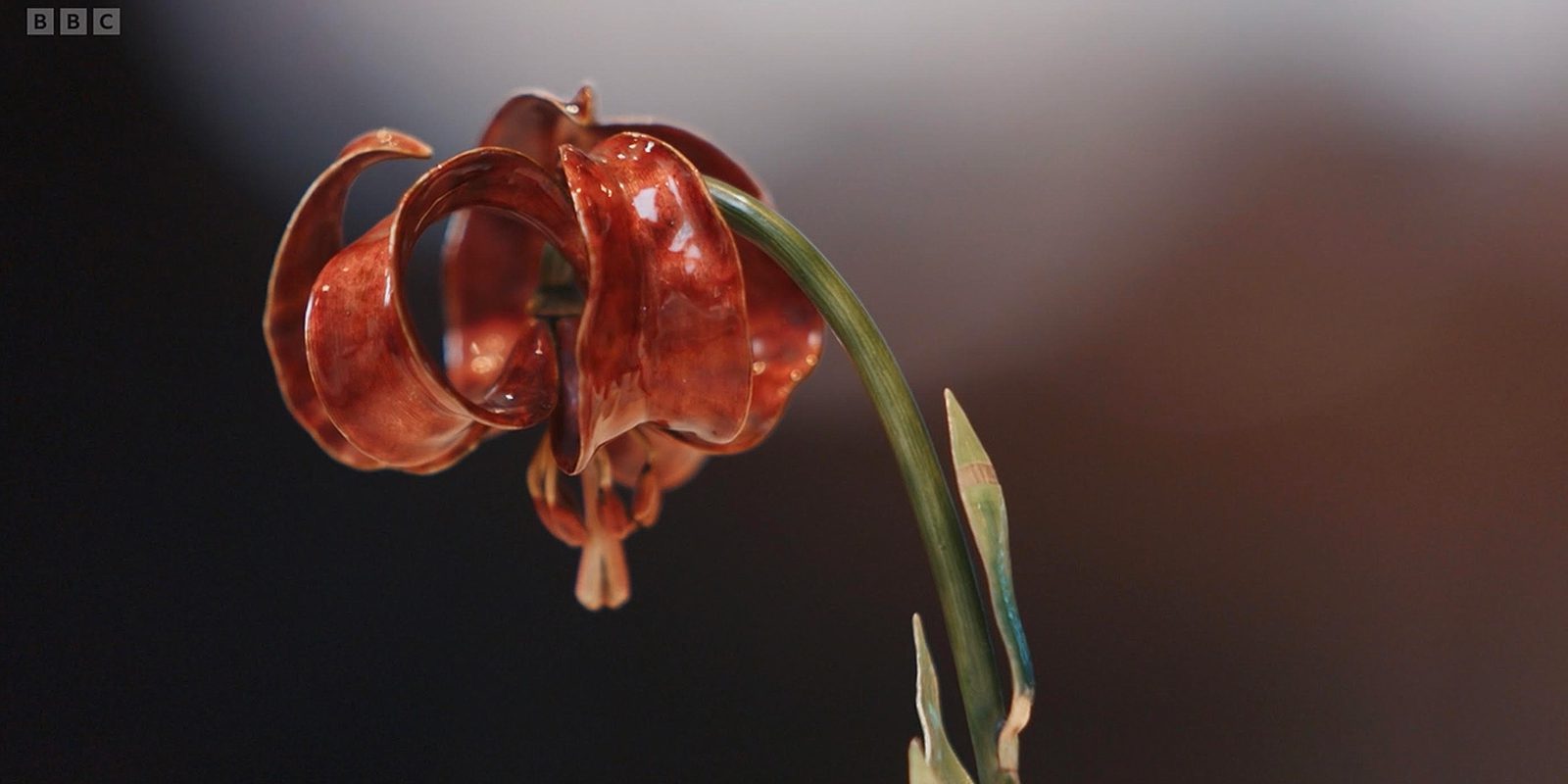
The BBC programme Fake or Fortune? broadcast on July 16 sent shockwaves through the Russian Artworld. It focused on a red enamel Lily which, in 2014, Bonhams unequivocally declared a Fabergé and valued at £200,000-300,000 (i.e. worth a small fortune). In 2021 they downgraded it to ‘style of Fabergé’ (i.e. a fake), slashing its potential value to £4,000.
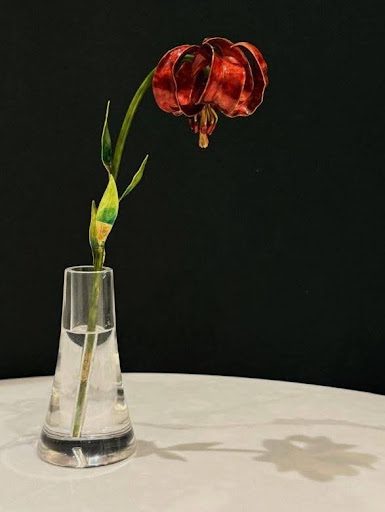
Fake or Fortune established that the Lily once belonged to Queen Helen of Romania (1896-1982), and was described in her Will as ‘the Fabergé flower in a vase in the vitrine in my sitting room.’ The show’s title is meant to imply uncertainty and controversy. For 57 minutes there wasn’t any: a welter of scientific evidence, on top of provenance, all pointed to a Fabergé origin. As the programme drew to a close it was in desperate need of a sting in its tail. It got one in the form of a recent Bonhams Statement, blithely disregarding all that had gone before:
Authenticating Fabergé pieces requires a rigorous examination of hallmarks, craftsmanship, quality and provenance, as the market is saturated with high-quality forgeries. The Fabergé flower vase in question was initially assessed from photographs. Upon first-hand inspection the team determined that it was not an authentic Fabergé piece and were therefore unable to offer it for sale.
There was no mention of who at Bonhams had done the assessing – or why hallmarks should be of relevance to Fabergé flowers (which usually don’t have any).
The last time Bonhams sold anything important by Fabergé (a Meshchanka hardstone figure) was a dozen years ago. We can only guess who drafted their ‘Statement.’ You would expect it to be Daria Chernenko, Head (in fact, these days Sole Employee) of their Russian Art Department, who has worked at Bonhams since 2012. Yet when I quizzed Dasha about the Lily she merely regurgitated the Bonhams Statement to Fake or Fortune.
My sources indicate that the Lily was in fact assessed by Bonhams Valuations Department, and Dasha (who studied Indian Art at Moscow State University and Web Design at the University of Westminster) wasn’t involved. Very strange! People usually go to a Valuations Department if they want something valued for insurance purposes. If they’re looking to sell, they contact the specialist Department concerned.
The Lily is an attractive specimen with petals of strikingly deep red enamel, although it is not in pristine condition (there are various chips, and the enamel cannot be perfectly restored). It belongs to a bubbly lady called Rachael (surname withheld), who comes from Liverpool but does not have a Scouse accent (probably why her Lily’s not Pink). She inherited the Lily in 2021 from Mary Priscilla Smith, second wife of Rachael’s maternal grandfather Austin D. Smith, a solicitor from Southport (20 miles up the coast from Liverpool). This provincial Mr Smith had extraordinary royal and international connections: Rachael provided a photo of him hobnobbing with Petar II, exiled King of Yugoslavia, and produced a telegram sent by the Queen after his death in 1987, extolling his ‘loyalty and wise counsel.’ A real Austin Powers !
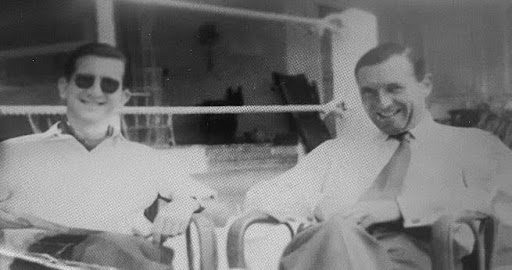 PETAR II OF YUGOSLAVIA & AUSTIN SMITH (c.1945-50)
I know lawyers need to be discreet, but this Mr Smith seems to have cultivated anonymity. The only information about him on internet is a mention in the 1939 Census. This records him aged 26, still living with his parents at their palatial villa in Southport’s Sandringham Road close to Royal Birkdale Golf Course.
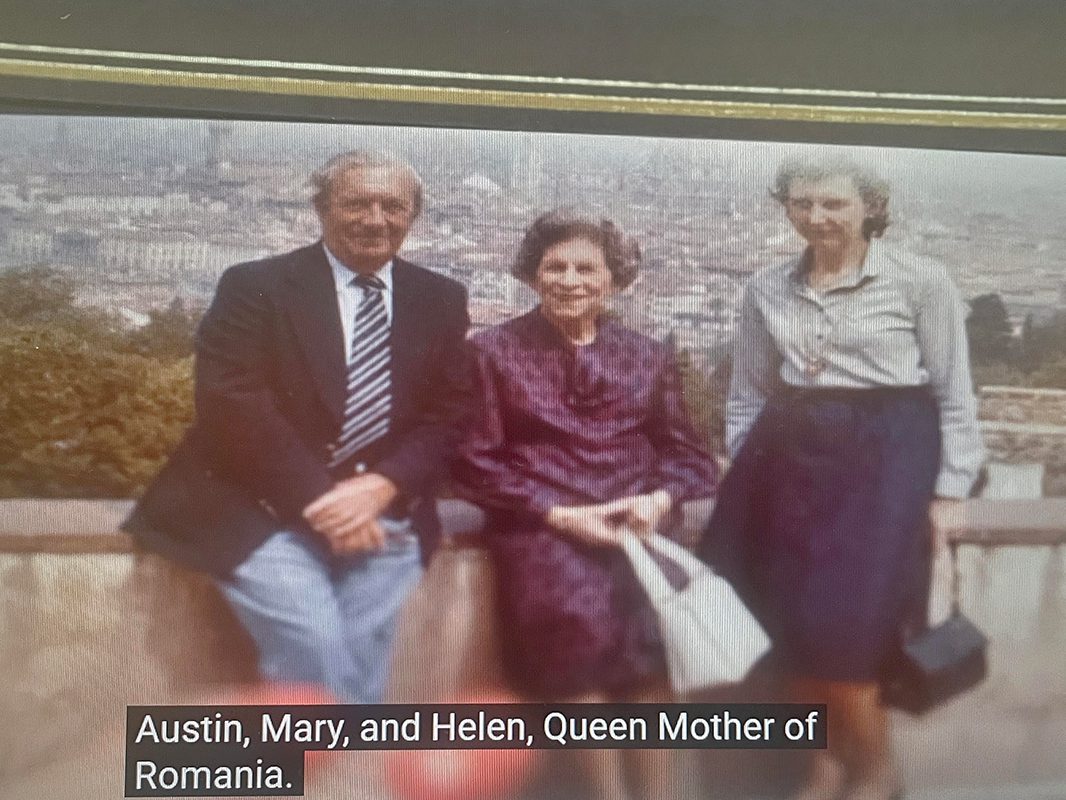
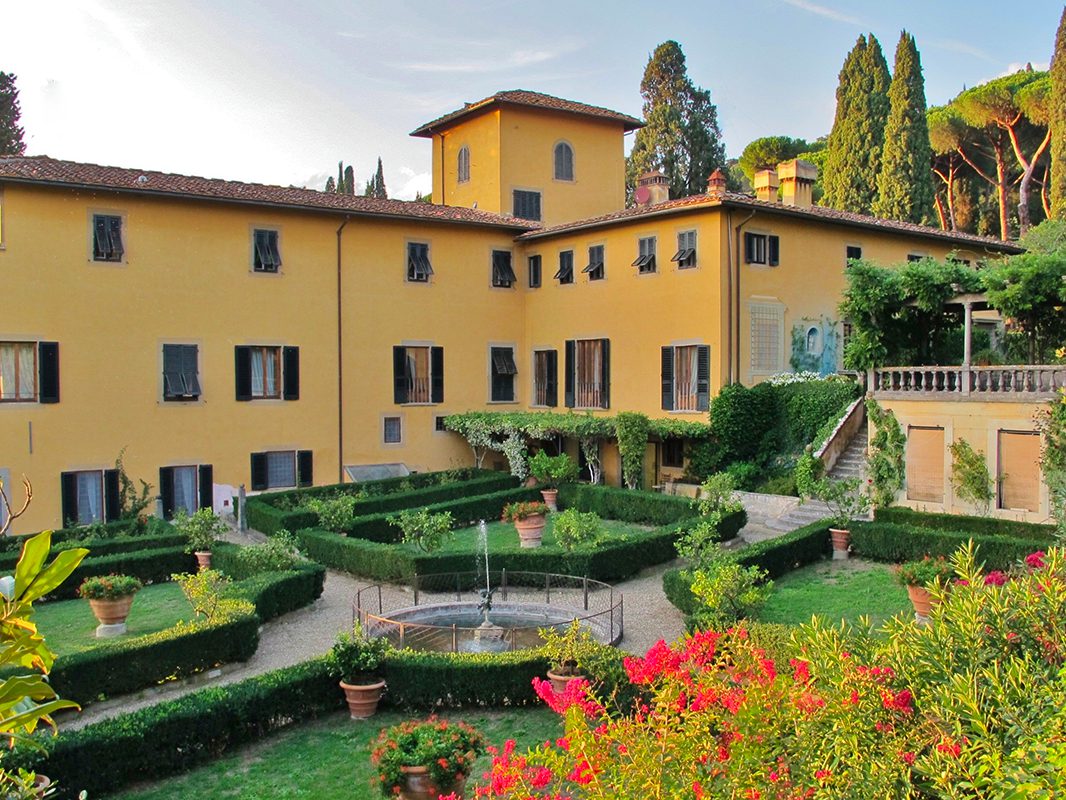
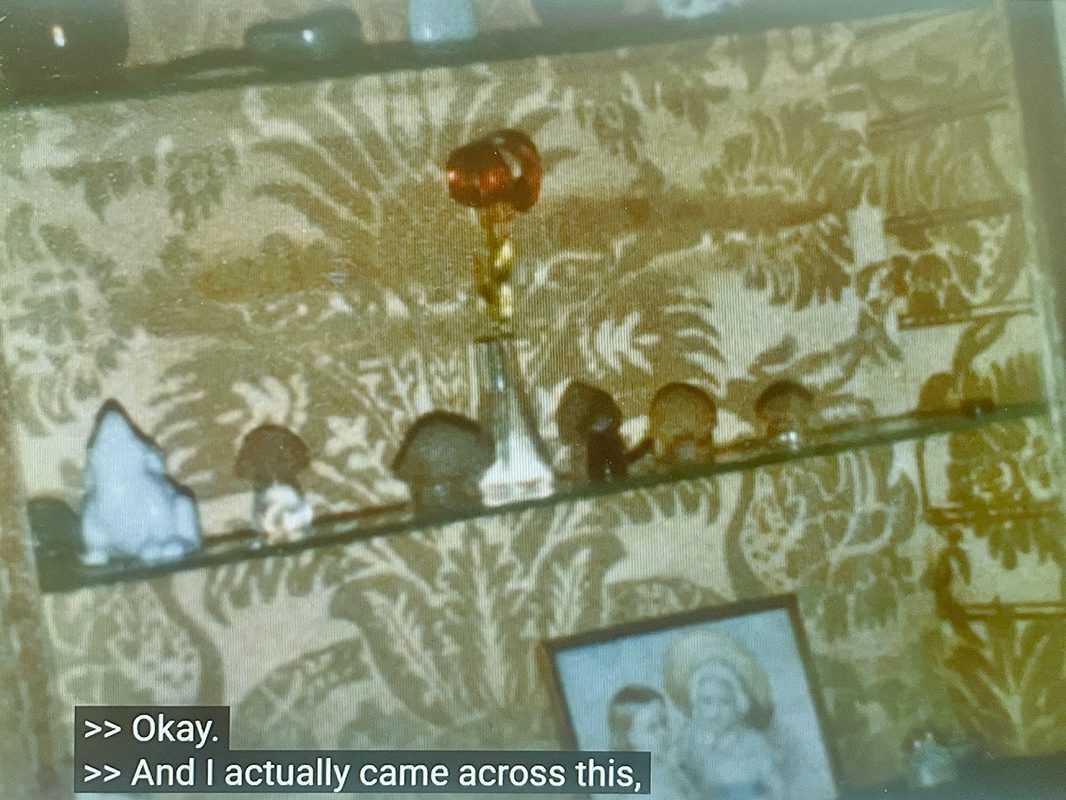
Austin was also a good friend of Queen Helen of Romania, to whom he was doubtless introduced by Petar II (Helen was his wife’s aunt). Rachael supplied the BBC with photos of Helen flanked by Austin & Mary Smith in Florence, and of Helen’s Lily in the lounge at Villa Sparta, her home in nearby Fiesole (where she was friends with Bernard Berenson).
-

- AUSTIN SMITH – HELEN OF ROMANIA – MARY SMITH (FLORENCE c.1975)
-
- VILLA SPARTA
-
- VITRINE AT HELEN OF ROMANIA’S VILLA SPARTA (FIESOLE)
Rachael also provided a photo of a Portrait of a Child by John Singer Sargent that Mary sent for auction in New York in 2006, when it fetched $2.65 million. The saleroom? Bonhams (as Fake or Fortune singularly failed to specify)… which explains why Bonhams, not the big boys (i.e. Sotheby’s and Christie’s), were consulted over the Lily a few years later. The painting was another gift to Austin & Mary from Queen Helen who (as Fake or Fortune also failed to specify) acquired it after the death of its previous owner, London artist Florence Garrard (a member of the famous jewellery family), in 1938.
The programme portrayed Rachael as a single-mother shop assistant living in a small flat, with a ‘life-changing’ need for the sort of money a Fabergé flower would provide. So what on earth happened to that $2.65m? We are told that Mary Smith was childless and treated Rachael like a daughter. How come she left her financially bereft? ‘Mother’ Mary was so well off that, when her Lily was valued at £200,000-300,000, she felt no need to sell!
Fake Or Fortune has been going since 2011. Its longstanding presenters Philip Mould (an Old Masters & Modern British picture dealer) and Fiona Bruce (a famous newsreader) are now in their sixties. Neither know much about Fabergé, but maintained professional enthusiasm throughout (Well done, sounds really promising!… this is something I need to share with Fiona… oh, that is not good news… I could tell you were really excited when you handed me that!). The pair meet for flirty exchanges in between their peregrinations, evoked by endless shots of Philip at the wheel of his white Ford or Fiona sitting in a train (artfully filmed to make it look as if she’s on a plane – as she would have been before the BBC’s much-touted budget cuts).

They are joined by 73 year-old Geoffrey Munn – who also appears with Fiona Bruce on the Antiques Roadshow, which invites the public to bring family heirlooms along for expert appraisal at a different UK venue each week. In 2018 Munn was shown a Fabergé Pear Blossom study commissioned for the Worcestershire Hussars. ‘Astonishing! Utterly breathtaking!’ he gasped, as if he’d never seen it before. In fact, the piece had been shown at a 1992 exhibition of Fabergé from Private Collections (catalogue n° 101) at Wartski – where Munn was then working.
In 2018 he declared it worth a million pounds. Yes, it’s a beautiful piece, with its original box – but I don’t remember any Fabergé flower ever bringing that kind of money at auction! The figure was just one Munn’s headline-seeking opinion, without any factual basis. Antiques Roadshow is all about discoveries – items that have been forgotten in the attic for decades… . Most of the things brought for inspection are, at best, a little intriguing and worth a few hundred pounds. Yet suddenly Geoffrey Munn attracts a seven-figure Fabergé! One he had known about for years! Why was such a famous work of art featured on the Antiques Roadshow? To enable Munn to create a sensation, and indulge in some kind of showmanship?
I suspect the Lily may have been brought along to another Roadshow (perhaps the one filmed at Liverpool’s Sefton Park in 2022), but diverted to Fake or Fortune when the BBC heard about Bonhams’ fluctuating valuations.
Munn worked at Wartski for donkey’s years before retiring in 2018. I first came across him when I was living in California. His then-assistant (later: successor) Kieran McCarthy invited me to ‘sell us something.’ I happened to be in London at the time, and had with me a beautiful Fabergé cane-handle with diamonds and enamel. We agreed on a price of £15,000… but next morning the deal was off. ‘Geoffrey thinks it might be a forgery’ mumbled Kieran.
After he left Wartski I called Munn with a view to maybe doing some business together, and suggested we have lunch. He replied that, for him, Fabergé was now ‘a thing of the past.’ Even so, Munn had the following to say about the BBC’s Lily: ‘I do feel, in the strongest sense, that this needs exploration’ he opined pompously. ‘Beware.’
An expert should say Yea or Nay rather than sit on the fence. Otherwise how can he or she be deemed an ‘expert’?
Viewers are advised that there’s no catalogue raisonné for Fabergé – ‘no cosy committee we can go to and say Thumbs Up or Thumbs Down?’ But to imply there’s nobody out there to authenticate works by Fabergé is bullshit. There are a host of Fabergé specialists whom Fake or Fortune could have consulted:
– Geza von Habsburg (ex-Christie’s Geneva then joint boss of Habsburg-Feldman), author of numerous Fabergé books and exhibition catalogues
– Alexander von Solodkoff, ex-Christie’s Geneva, another longstanding curator and author in the Fabergé field
– Ulla Tillander, Fabergé author and lecturer with in-depth knowledge of Fabergé workmasters
– Kieran McCarthy, head of Wartski and curator of the blockbuster Fabergé Romance to Revolution exhibition at the V & A in 2021
– Margo Oganesian, Head of Russian Art at Christie’s London, who sold five Fabergé flowers once owned by Matilda Geddings Gray for a total $1.8m on 10 June 2026
– Helen Culver-Smith, Global Head of Russian Art at Sotheby’s
– Nick Nicholson, Head of Russian Art at Heritage Auctions (Dallas)
– Caroline de Guitaut, Surveyor of the British Royal Collection – her post would not have allowed her to express a public opinion, but could have been consulted privately
– Stephen Dale, Fabergé author and veteran dealer
I had a call from the BBC saying they were doing a programme about Fabergé for Fake or Fortune, and would like to discuss it with me. But I never heard back. Very odd! – Nobody, to my knowedge, has written more about Fabergé fakes than I have (Fiona Bruce was even shown brandishing an Artnet News article about my denunciation of the ‘tawdry’ fakes in the Fabergé exhibition at the Hermitage in 2020/21 – see below). Plus I’ve watered a gardenful of Fabergé flowers over the years!

Instead, the BBC reeled in Cynthia Coleman Sparke – ‘a Russian speaker and a Fabergé expert’ – for a gushy exchange with Fiona Bruce about a 1917 inventory of no relevance to the Lily except that the collector involved, Grand Duchess Maria Pavlovna, ‘was hugely keen’ on Fabergé flowers. ‘Mary Pavlovna was married to a very prominent member of the Romanov family, the monarchs of this extraordinary empire’ cooed Cynthia. Incoherent superlatives cascaded from her lips as her excitement swelled. ‘And this really is the story of the end of empire! So – enormous wealth! Massive patrons! Extraordinary palaces in St Petersburg!’. None of this has any relevance to the flower in question.
I’ve known Cynthia since way back. She’s a nice gal. A couple of months ago she sent me a quick e-mail saying she’d heard I was dead. Who in their warped, deranged mind could send such a crazy message? What the hell was she thinking? Was she hoping I’d snuffed it? In 2014 Cynthia published a book called Russian Decorative Arts featuring at least 63 items from the notorious Baden-Baden Collection, amassed/commissioned by our old friend ‘Professor’ Ivanov who contributed the ‘tawdry fakes’ to the Hermitage Fabergé exhibition cited above.
In days gone by Cynthia worked for Asprey and headed Christie’s Russian Department in New York. From 2008 she worked for… Bonhams, as the BBC singularly omitted to mention. Why didn’t Fiona Bruce ask Cynthia if she was involved in valuing the Marsh Lily at £200,000-300,000 in 2014 – and whether she was part of the team that subsequently downgraded its worth to just £4,000? If not, just who was (or were) the so-called Bonhams expert(s) involved? Let’s have some names!
Fake or Fortune was on firmer ground when it came to science. There was insight from an enamel specialist; from the Courtauld Institute (XRF analysis); from the Gemmological Association of Great Britain, confirming the flower’s materials were bona fide; and from the Royal Horticultural Society, identifying precisely what type of lily was being assessed. Philip Mould was told it was a Martagon variety Cattaniae named in honour of Maria de Cattani, who discovered it in Croatia in 1865. In other words, a species of Marsh Lily.
Be all that as it linguistically may, the flower is more likely to be another type of Marsh Lily, one endemic to the Urals and Siberia: the not dissimilar Lilium martagon Pilosiusculum, first recorded by Austrian botanist Josef Franz Freyn in his Plantae Karoanae published in 1890 – just a few years before our enamel flower was probably made. Carl Fabergé, in other words, was celebrating the discovery of a new type of lily on Russian soil. Surely even the BBC could have afforded a researcher to spend 20 minutes’ googling in order to ascertain such a crucial fact?
There was valuable input from the Washington-based Fabergé researcher Vincent Palmade who pointed out – albeit only via Skype (ah, those BBC cuts!) – that the Lily in the vitrine at Villa Sparta was flanked by five Fabergé crystal mushroom seals, and revealed that Helen of Romania owned ‘at least 83 Fabergé pieces’ before selling most of them at auction: first in 1956 at Sotheby’s London, then in 1977 at Christie’s Geneva, including three flowers. (Helen’s income evaporated after 1947 with the end of the Romanian monarchy; in 1973 she was compelled to mortgage Villa Sparta, and in 1976 she sold Wildenstein an El Greco St Sebastian that she had spirited out of Romania in 1947.)
Together with his Russian wife Anna, Vincent Palmade did a stellar research job that also yielded the following observations sadly spurned by the BBC:
* Queen Helen built up an ‘extensive and distinguished Fabergé collection’ before the outbreak of World War II, doubtless funded by her lavish pension as ex-Queen of Romania.
* Queen Helen lent only a writing-set by Nichols & Plincke (St Petersburg 1862) to the fabled Exhibition of Russian Art at Belgrave Square in London in 1935 that featured many outstanding Fabergé pieces, including Flowers and Imperial Eggs – suggesting she had yet to begin collecting Fabergé at the time. The Palmades believe Helen acquired the Lily in late 1930s London, when the market was a-bloom with Fabergé flowers: Wartski acquired several Fabergé flowers from the Soviet government after 1934; no fewer than 21 different Fabergé flowers were auctioned in London between 1934-37.
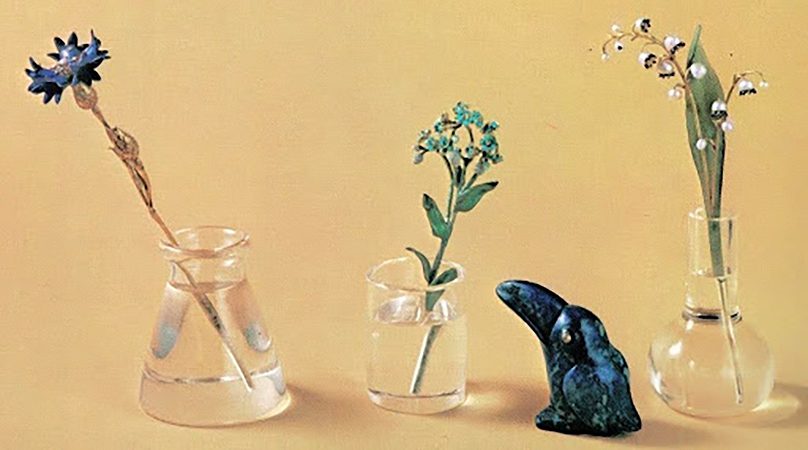
* Helen’s consignments to Christie’s Geneva on 9 November 1977 included three Fabergé flowers: a Cornflower, a sprig of Lily-of-the-Valley and a small bunch of Forget-me-Nots with enamel leaves. The Palmades tracked down the catalogue photograph showing all three works (alongside an obsidian raven-head):
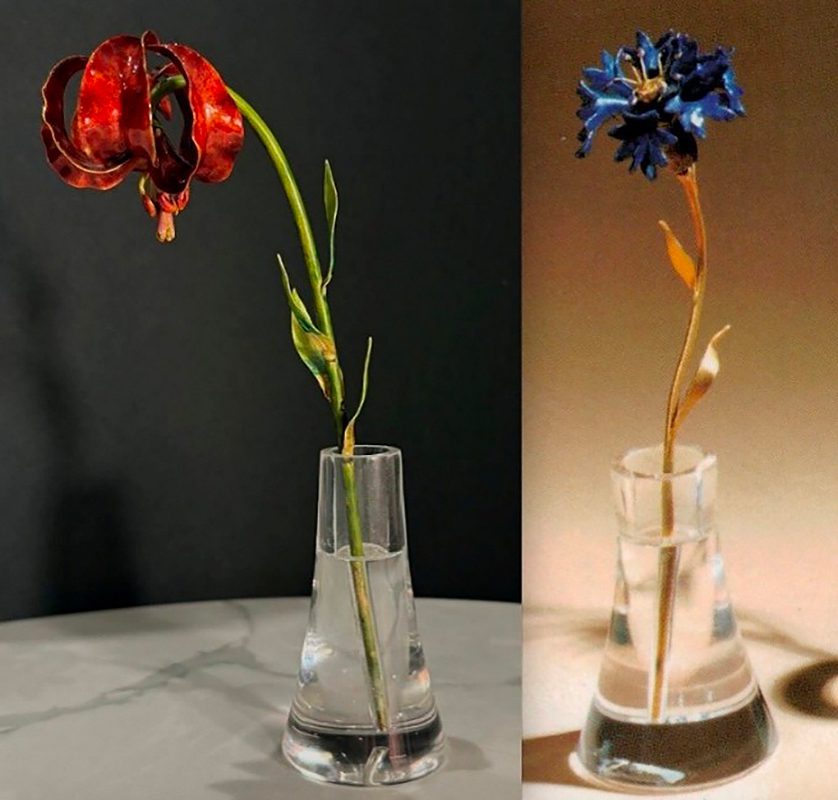
* The Lily’s rock crystal vase is virtually identical to that of the Cornflower featured on the cover of the catalogue of a Fabergé show held at A La Vieille Russie in 1983. Both flowers have the same proportions in relation to their vase:
* As well as unearthing Fabergé’s original photograph of the Forget-me-Nots, the Palmades found evidence that they were first sold by Fabergé’s London store on 23 December 1916, and acquired for £30 at Christie’s on 5 July 1937 by Frederick Berry Ltd of 25 Conduit Street – who doubtless sold them to Queen Helen prior to the outbreak of World War II.
* The Palmades identified two further Fabergé flowers that are close to the Marsh Lily in terms of size and materials:
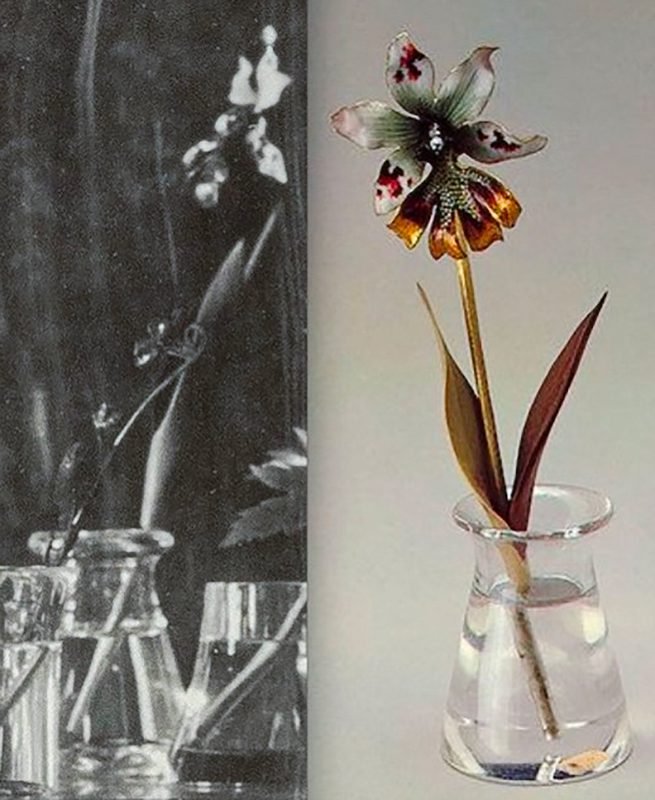
(1) an Orchid now in the Hermitage (below right) shown at the St Petersburg Von Dervis exhibition in 1902, when it was photographed in black-and-white (below left). This Orchid is 17.4cm tall (Marsh Lily : 19cm), and also has enamelled – not nephrite – leaves and stem.
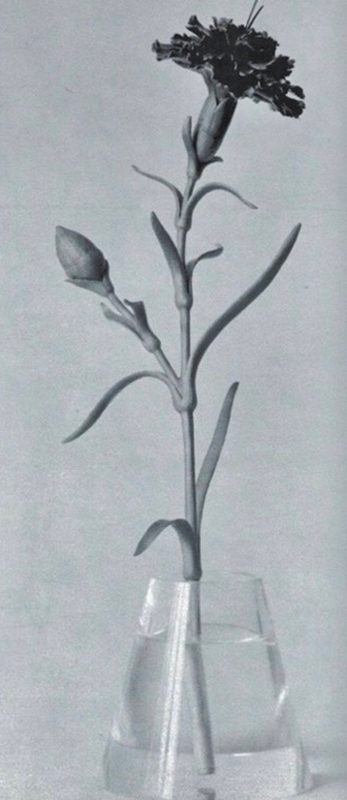
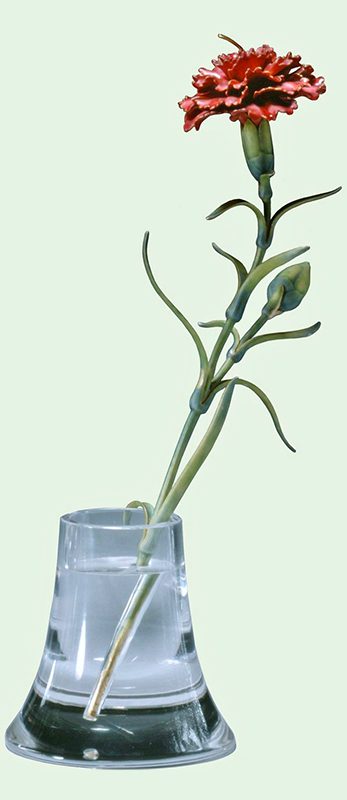
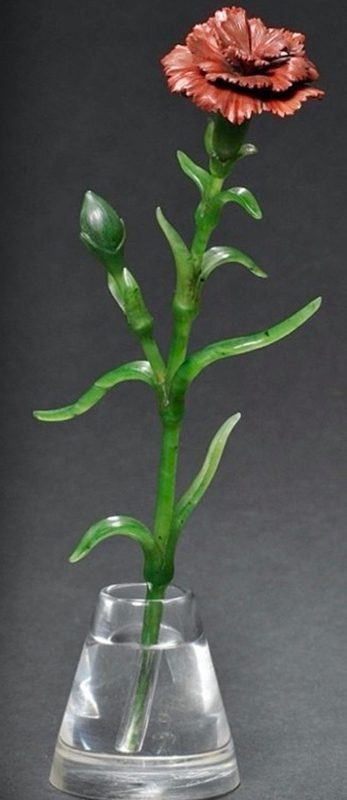
(2) a Carnation in the British Royal Collection, 17.9cm tall, also with enamelled leaves and stem. Bonhams tried to auction a crude copy of this on 5 June 2013 (Lot 97). Yes, the same Bonhams which declared the Marsh Lily a fake! Their catalogue entry records it as shown at the Fabergé-Cartier – Rivalen am Zarenhof exhibition in Munich in 2003 (n° 384, pp 258/9) as owned by ‘Professor’ Ivanov’s Russian National Museum; then at Ivanov’s Iskusstvo Fabergé show in Kostroma in 2010. At the time of auction, revealed Bonham’s catalogue, this Carnation was in the ‘Russian National Museum’ in Baden-Baden. In other words, ‘Professor’ Ivanov was the consignor.
Bonhams gave the height of Ivanov’s Carnation as 18.5cm, and called it ‘an important jewelled hardstone model of a Carnation… Fabergé, c.1890s, probably by workshop of Mikhail Perkhin.’ Their Russian Department gave it a stratospheric estimate of £450,000-550,000. Again, just who decided on that estimate? The carnation comprehensively failed to sell. So much for Bonhams’ botanical expertise! Bonhams compared it naïvely (and anachronistically) to ‘a very similar example in the collection of Queen Alexandra’ (wife of Edward VII and sister-in-law of Tsar Alexander III), who had been dead since 1925. It’s worth noting that, under the stewardship of Cynthia Coleman Sparke, Bonhams’ Russian Department offered a panoply of dubious ‘Fabergé items’ owned by ‘Professor’ Ivanov.
The two Carnations can be compared below. The one in the Royal Collection is pictured centre, flanked by its original Fabergé photograph (left) and the Ivanov/Bonhams version (right). Although the Royal Collection’s Carnation has lost its original vase (as often happens with Fabergé flowers), it is a far more convincing botanical match – including pistils – and has slender enamelled leaves rather than the chunky nephrite leaves used in Ivanov’s amateurish imitation.
Six months later, on 27 November 2013, Cynthia Coleman Sparke steered another Ivanov forgery into Bonhams’ London saleroom: a nephrite Buddha, 17cm high, with an estimate of £500,000-700,000 (Lot 87). It, too, failed to sell.
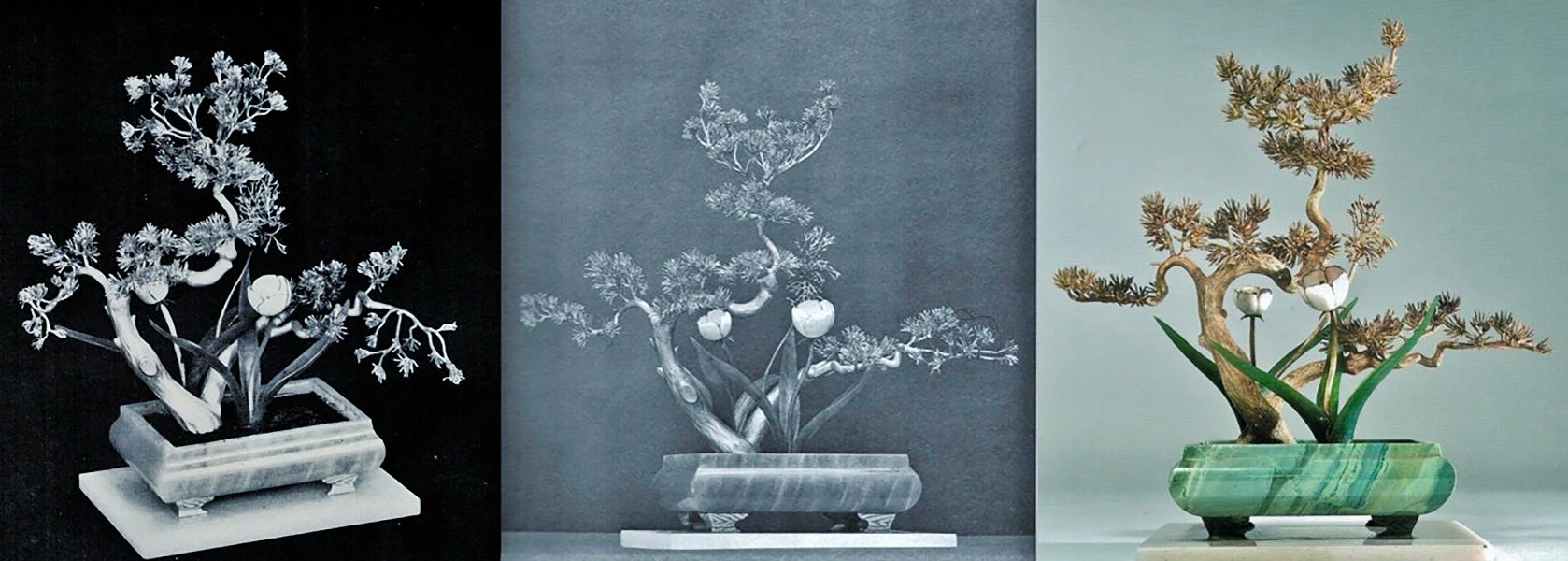
The Carnation is not the only dodgy ‘Fabergé’ plant associated with ‘Professor’ Ivanov. Take the Bonsai pictured below centre (original Fabergé photograph), initially owned by Lady Gwladys de Grey, Marchioness of Ripon (a patron of Diaghilev’s Ballets Russes and granddaughter of St Petersburg aristocrat Ekaterina Vorontsova). Compare this Bonsai with the images on either side: a photo published in 1949 in Peter Carl Fabergé: Goldsmith and Jeweller to the Russian Imperial Court (plate 75) by Charles Bainbridge (left); and a Bonsai owned by ‘Professor’ Ivanov (right) illustrated in his 2011 catalogue Время Фаберже (‘Age of Fabergé’). It is clear that the patterning and proportions of the stone base of the Ivanov piece differ markedly from the Fabergé original.
The BBC would have been well advised to afford more coverage to the Palmades’ findings. Their programme was glib and shoddy in several respects, not least in failing to mention how Bonhams made fools of themselves over Ivanov’s fake Carnation. (Incidentally, the programme was available on YouTube – www.youtube.com/live/5mWjKevD2MU – shortly after it was aired… then taken down a few days later. Why? And at whose behest?)
The programme’s conclusion was so lazy and nonchalant you felt the BBC had run out of money and time, and needed to shoot off to the Weather Forecast. Just how much of the new evidence unearthed by the programme was made available to Bonhams before they drafted their dismissive Statement? Why weren’t Bonhams invited to debate their position in person with Mould, Bruce and owner Rachael? If Bonhams were invited, but declined, why weren’t we told?

Above all, the BBC were irresponsible and totally unprofessional in failing to show the Lily to Sotheby’s, Christie’s or any of the Fabergé specialists listed above. Instead we were left with Phillip Mould wringing his hands and declaring bravely:
‘So: let’s just see. Let’s, as we say, return to this, shall we?’
‘This story is not over’ replies Fiona smugly. ‘Case not closed.’
You bet. It’s about to explode.