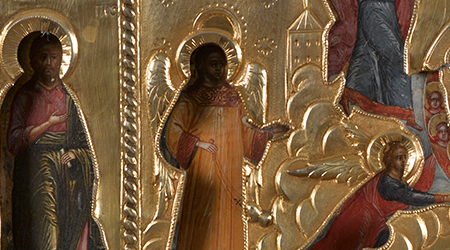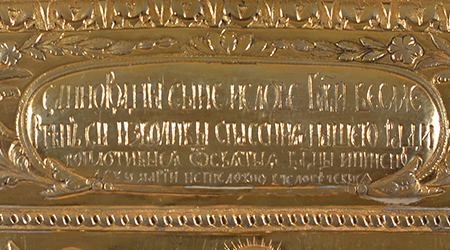
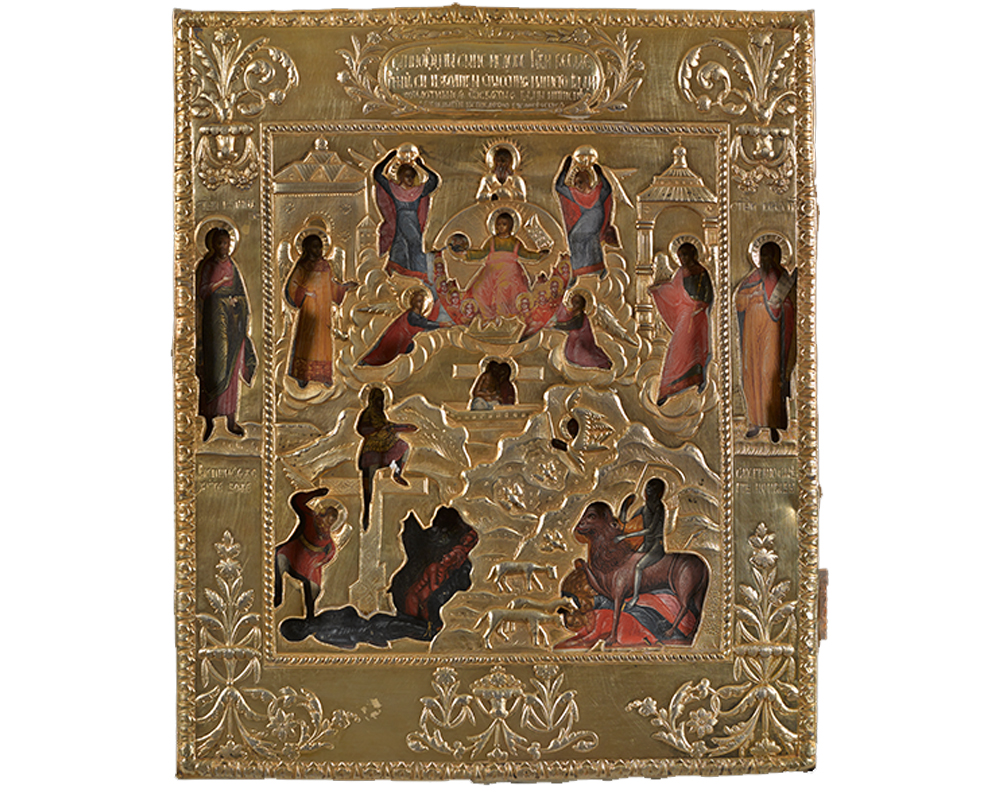
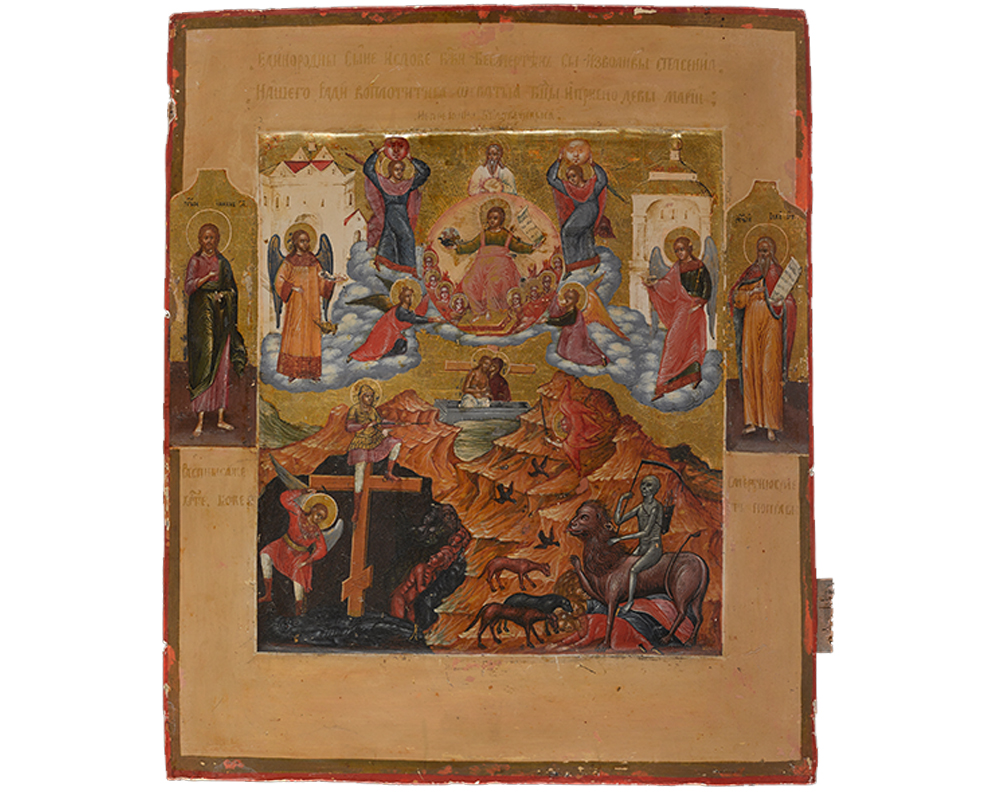
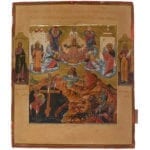
The icon portrays one of the rarest and the most complex iconographic subjects, based on the so-called Justinian’s Hymn or The Hymn of the Incarnation. It sets forth the Orthodox teaching on the Second Person of the Trinity, the Only-begotten (one in essence) Son and Word of God, who, being immortal, became man, without ceasing to be God, and accepted a human body from the Holy Theotokos, and overcame death at the cross:
Only-Begotten Son and Word of God immortal, / And the one willingly for our salvation incarnate of the Holy Birthgiver of God and Ever-virgin Mary, / Who without change became man, / And was crucified — Christ God, / Trampling down death by death, / Who are one of the Holy Trinity, / Glorified with the Father and Holy Spirit, save us.
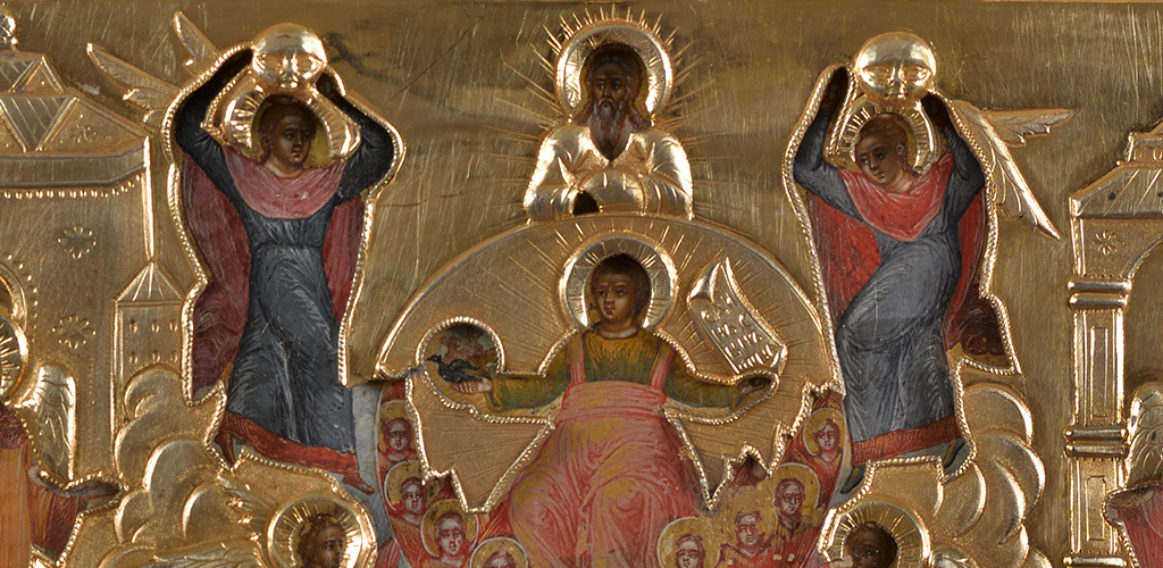
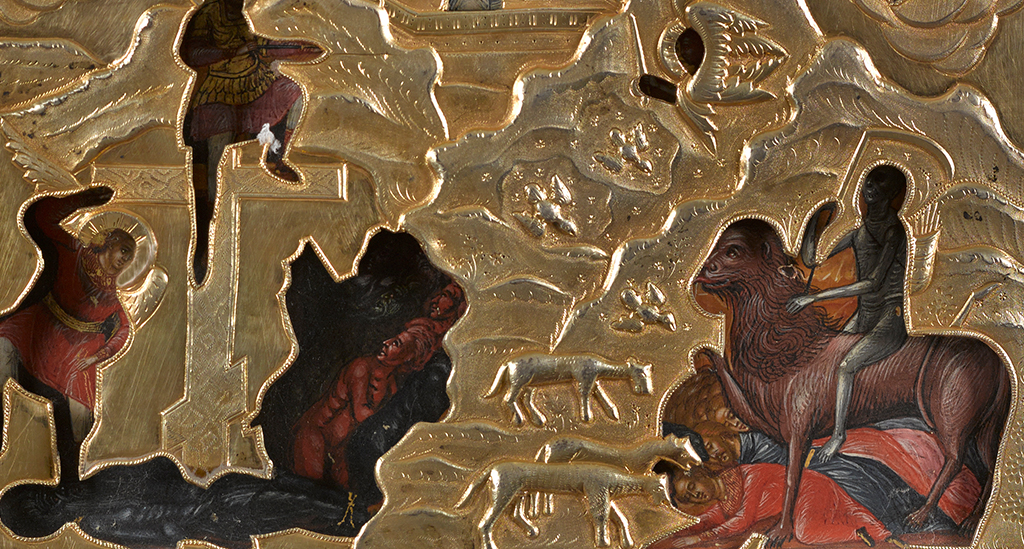
The upper part of the composition shows a variant of the New Testament Trinity: Lord Sabaoth depicted as an old man with a white beard, the Holy Spirit as a dove, and Jesus as Christ Immanuel surrounded by seraphim in a mandorla. In one hand Christ holds an open scroll with the inscription “Only-Begotten Son and Word of God.” In the other is an orb with the symbols of the Four Evangelists: an eagle for John, a lion for Mark, an ox for Luke, and a winged man for Matthew. The mandorla is supported by two angels, two others are shown holding the sun and the moon. The scene is flanked by another pair of angels. The centre of the composition is occupied by Do Not Weep For Me, Mother, the Eastern Orthodox version of the Pietà, showing the Virgin Mary holding the body of her dead son. In the lower left is a cross, and Jesus clad in armour sittingatop it, symbolising His victory over death. Below the cross is a Satan being slain by an angel. The lower right part show Death riding on a lion over the bodies of the fallen, devoured by wild beasts and vultures. Above is a winged seraph holding a sword.
The triple representation of Christ, as Immanuel, crucified Jesus and an armoured warrior, serves an illustration of the Trinitarian doctrine: the triune nature of God, His Mercy (Pietà) and His victory over death by His crucifixion.
The iconography of The Only Begotten Son first appeared in Russia in the 16th century, the composition most likely originated in the Christian East and was created by a Byzantine religious scholar.