
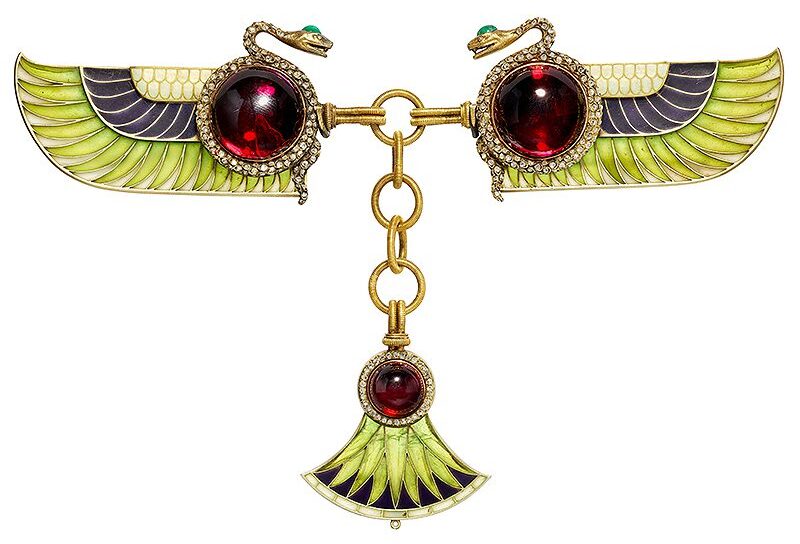
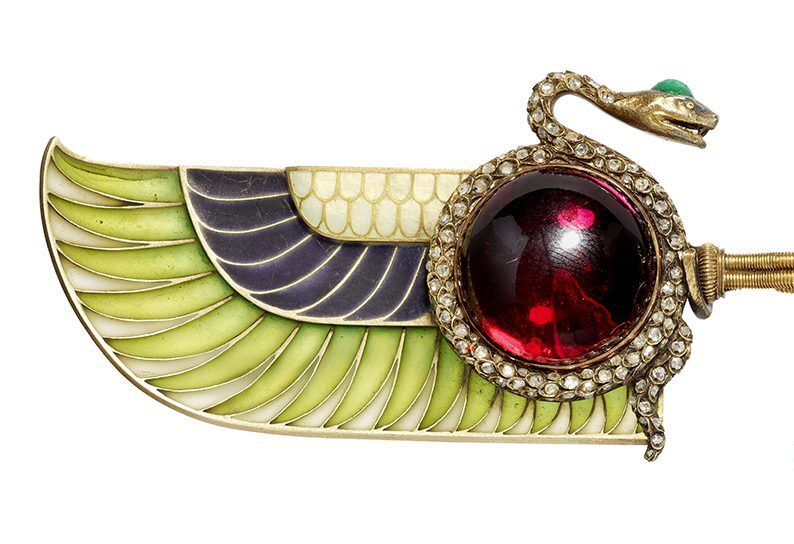
 THIS EXCEPTIONAL FABERGÉ CAPE-CLASP TELLS A FASCINATING STORY.
It takes the form of wings and tail-feathers in green, white and midnight blue enamel, linked by a gold chain and set with blood-red garnet cabochons ringed by tiny rose-cut diamonds. Two snakes, symbolizing the Egyptian cobra goddess Wadjet, protrude from the rims of the upper cabochons sporting natty emerald caps. The clasp bears the ЯА hallmark of St Petersburg’s Hjalmar Armfeldt.
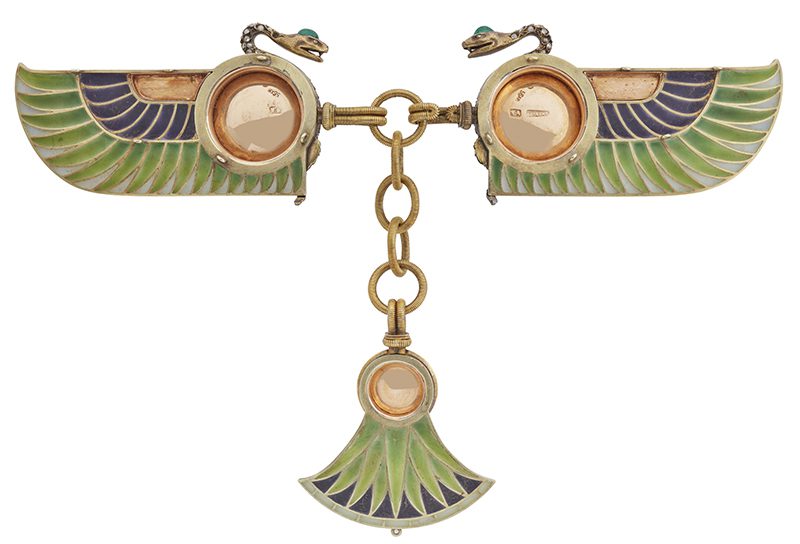
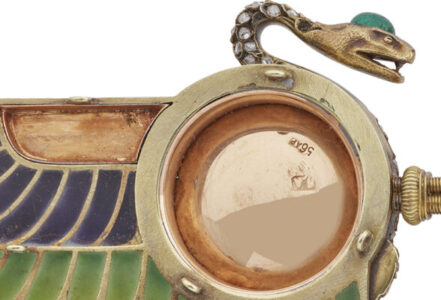
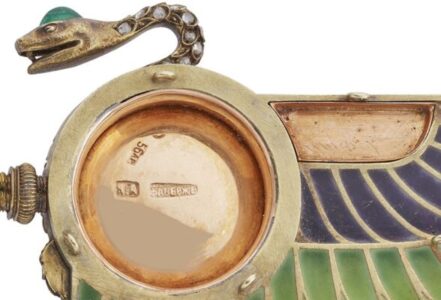
FABERGÉ’S EGYPTIAN STYLE
The Cape-Clasp is a rare example of Fabergé’s ‘Egyptian Style,’ and can be linked to sketches unearthed in a Fabergé design album by Moscow researcher Elena Korneychuk in 2017. These feature outspread wings in coloured enamel – a technique, says Korneychuk, that originated in Ancient Egypt. The shades of the enamel are noted in pencil alongside, while the firm’s date-stamp (with the year 1904) is partly discernible top right. The designs incorporate the head of either a Cobra (Wadjet, Goddess of Lower Egypt) or Vulture (Nekhbet, Goddess of Upper Egypt):
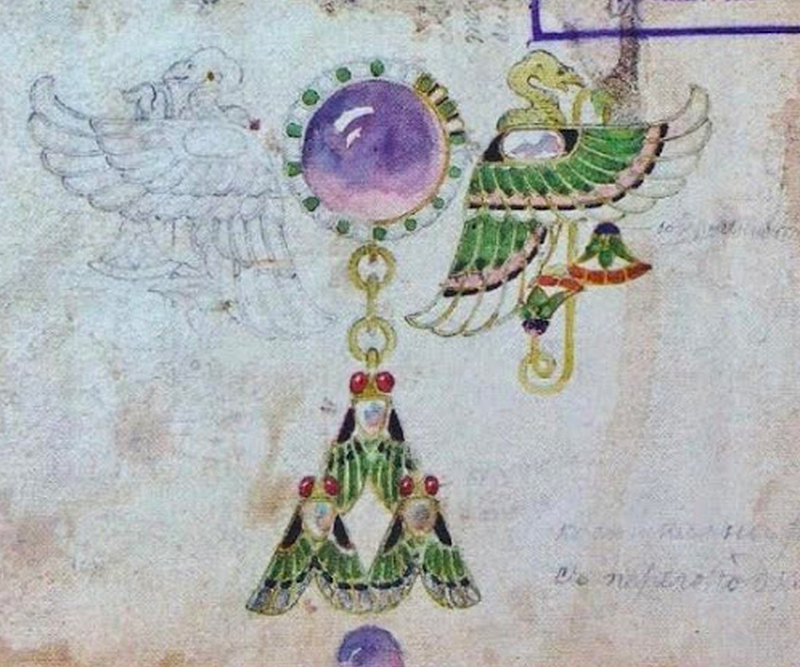
Korneychuk believes the designs were inspired by a gold pendant necklace discovered in the tomb of Queen Ahhotep (16th century B.C.) by the French Egyptologist Auguste Mariette, and shown at the Paris Exposition Universelle of 1878. Many French jewellers subsequently produced items aesthetically indebted to Ancient Egypt – but the style was ‘almost completely neglected’ by Russian jewellers apart from Fabergé, reports Korneychuk. Even so, ‘Fabergé’s interest seems modest. Among the thousands of objects produced by the firm it has scarcely proved possible to identify two dozen in Egyptian style.’ She believes this ‘cautious attitude’ reflects the fact that the imagery of Ancient Egypt was associated with Freemasonry – banned in Russia from 1822-1905.

All the ‘Egyptian-Style’ Fabergé items Korneychuk tracked down were made between 1890 and 1915. The earliest was a Four Sphinxes match-holder purchased by Tsar Alexander III & Empress Maria Feodorovna for 100 rubles on 5 December 1890. A Fabergé match-holder incorporating silver pharaoh heads and lion-paw legs was made for their son after he had become Nicholas II.
Maria Feodorovna purchased a crystal ‘Egyptian Mummy’ seal for 175 rubles in 1897 and a Fabergé nephrite ‘Mummy’ paperweight for 400 rubles in 1900. Her brother King George of the Hellenes owned a miniature box with lid in the form of a quartz scarab symbolizing Ra, the Egyptian Sun God.
In April 1897 Empress Alexandra purchased a pair of cufflinks with scarabs for 435 rubles. In February 1898 Nicholas II gave Alexandra a glass vase with two relief medallions depicting a bird and sphinx, with pyramids in the background and a Rappoport base incorporating three silver sphinxes.
EGYPTIANS BY THE NEVA
Elena Korneychuk asserts that ‘the overwhelming majority of Fabergé’s surviving Egyptian works bear the marks of the Moscow branch.’ She cites only one workmaster from St Petersburg as making pieces in Egyptian Style: Albert Holmström, who produced a platinum-mounted emerald ‘beetle’ [i.e. scarab] pendant with sapphire and diamond wings in 1913, and made two Egyptian items to the design of Franz Birbaum – notably a nephrite, diamond and ruby pendant in the form of a nemes head-cloth, bought by the Tsar’s cousin Grand Duke Andrei for 380 rubles on 21 March 1915.
Korneychuk, however, underestimates the popularity of the Egyptian Style amongst Fabergé’s St Petersburg craftsmen. Apart from Hjalmar Armfeldt – the maker of our Cape-Clasp – their number also included the illustrious Henrik Wigström, whose gold necklace incorporating an enamel and diamond vulture, with two turquoise scarab pendants dangling from its talons, surfaced at Genève Enchères on 13 December 2016, selling for CHF75,000 (around $105,000 in today’s money). Had the auctioneers not misidentified the vulture as a ‘falcon’ it might have flown even higher.
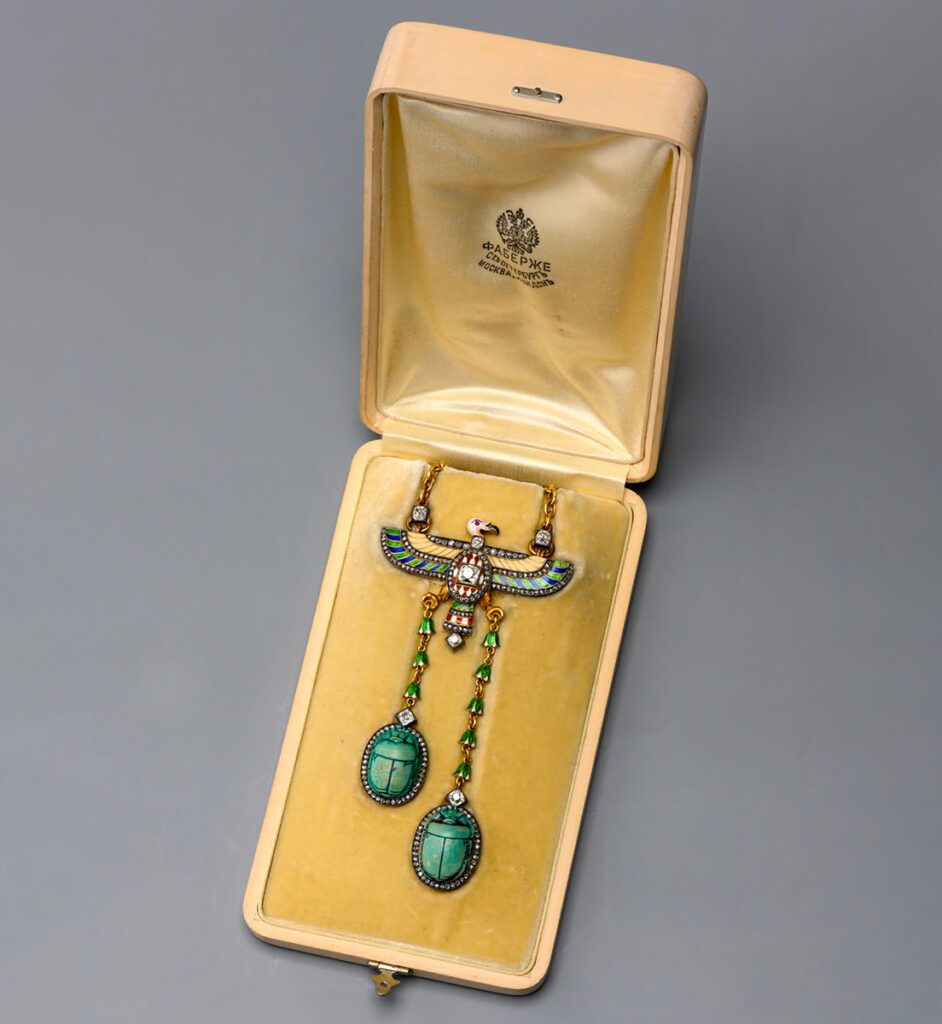

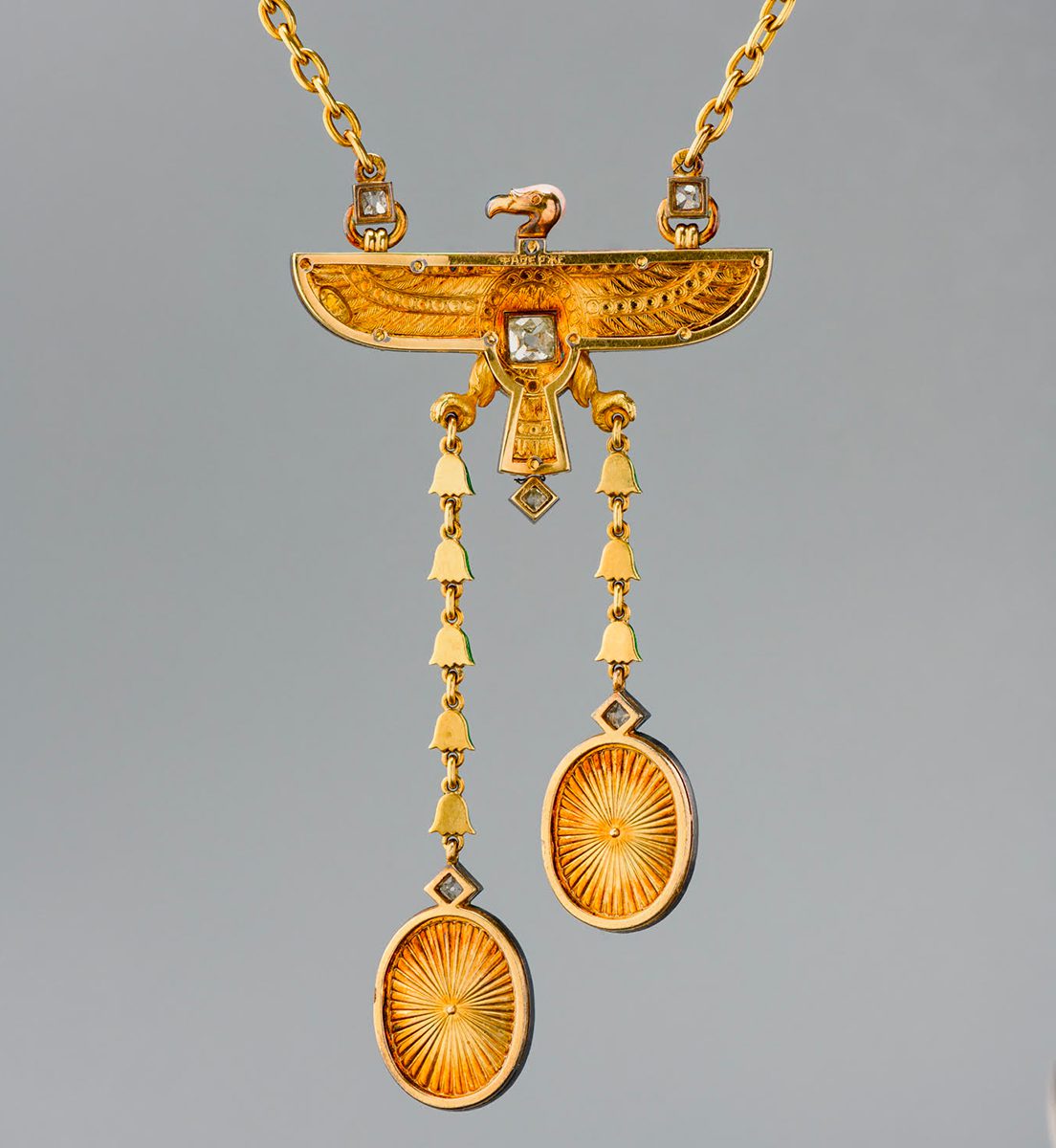
The back of the vulture is stamped 72 (золотники) lower left and H.W. (Henrik Wigström) lower right, with a scratched ФАБЕРЖЕ mark below the head. The survival of its fitted case means there can be no doubt as to its authenticity. Fabergé occasionally used a scratched (rather than stamped) signature – as on the Winter Egg. All the morons who claim this scratched signature means the Winter Egg is a fake are ignorant fools and deserve to rot in Hell (the Winter Egg, incidentally, was made by the Albert Holmström mentioned above).
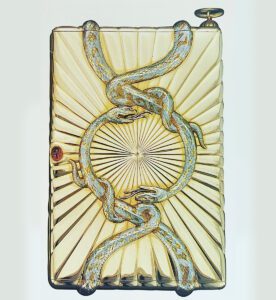
Interestingly, Henrik Wigström and Hjalmar Armfeldt shared a liking for Egyptian-looking snakes. Armfeldt was the author of a lozenge-shaped purpurin dish, with silver snake slithering around the rim, sold at Sotheby’s Geneva in May 1993. Wigström embellished a gold cigarette case made for Princess Cécile Murat in 1911 with intertwining platinum snakes.

CAPED CRUSADER : THE CLASP’S FIRST OWNER
Walter Winans (1852-1920) purchased the Armfeldt Cape-Clasp from Fabergé’s store at 48 Dover Street on 13 April 1908. At £75 10s (then equivalent to 750 rubles) it was more expensive than any of the Egyptian Style items cited by Korneychuk. Winans was 56, and just three months short of immortality: on 10 July 1908 he would win Gold for the U.S.A. in the Running Deer Double-Shot at the London Olympics. At the time he had never set foot in America. He was, in fact, the first man born in Russian ever to land Olympic Gold (four months before Nikolai Kolomenkin won Gold for Figure-Skating).
Winans had been a regular customer since Fabergé opened in London in 1903, mostly buying jewels or dress accessories like combs or hat-pins. He loved emeralds: on 11 December 1907 he acquired an emerald and diamond pendant for £267 then, a few months later, a pair of emerald and diamond ear-rings for £232. Many of his purchases, including the most expensive (a blue sapphire for £516 on 14 August 1909), were made on his behalf by Constance Meade of 15 Eaton Terrace, Belgravia – later benefactress of the great papyrologist John de Monins Johnson, who spoke Arabic and worked in the Egyptian Civil Service before embarking on an academic career at Oxford (where he is commemorated by the John Johnson Collection in the Bodleian Library).
Walter’s younger brother Louis (1857-1927) also collected jewellery: in 1909 he bought the 32.24-carat Agra diamond – the seventh-largest pink diamond in the world (sold by Christie’s for £4,070,000 in 1990).
The Winans were among the richest men in the United Kingdom – despite being Americans who grew up in Russia.
Walter Winans was born in St Petersburg on 5 April 1852, in an elegant mansion on the Schlüsselburg Trakt (now Obukhovskaya Oborony Prospekt) by the River Neva, close to the Imperial Porcelain Factory. It had all mod cons (i.e. running water) and an attic full of servants (footman, coachman, gardener, butler, washerwoman and cook). There was a vast garden with summerhouse, greenhouse, bathhouse, stables, icehouse and orchard.
 WALTER WINANS’ BIRTHPLACE
The mansion was home to the families of William Winans (Walter’s father) and his elder brother Thomas. A matching house, 350 yards away on the other side of Alexandrovsky Foundry, was occupied by the famileis of their associates Joseph Harrison and Andrew Eastwick. Foundry and houses still stand.
The Foundry entered production in 1826, two years after the devastating flood (evoked by Pushkin in his epic poem The Bronze Horseman) that left 158 dead at St Petersburg’s previous ironworks on the Peterhof Chaussée by the Gulf of Finland. Alexandrovsky initially produced steamships and iron animals to embellish monuments and buildings (e.g. the horses on the Narva Triumphal Arch or the quadriga atop the General Staff Building on Palace Square). In 1842 the Foundry was recast as the hub of Russia’s nascent rail industry, tasked with producing rolling stock for the new St Petersburg-Moscow railway.
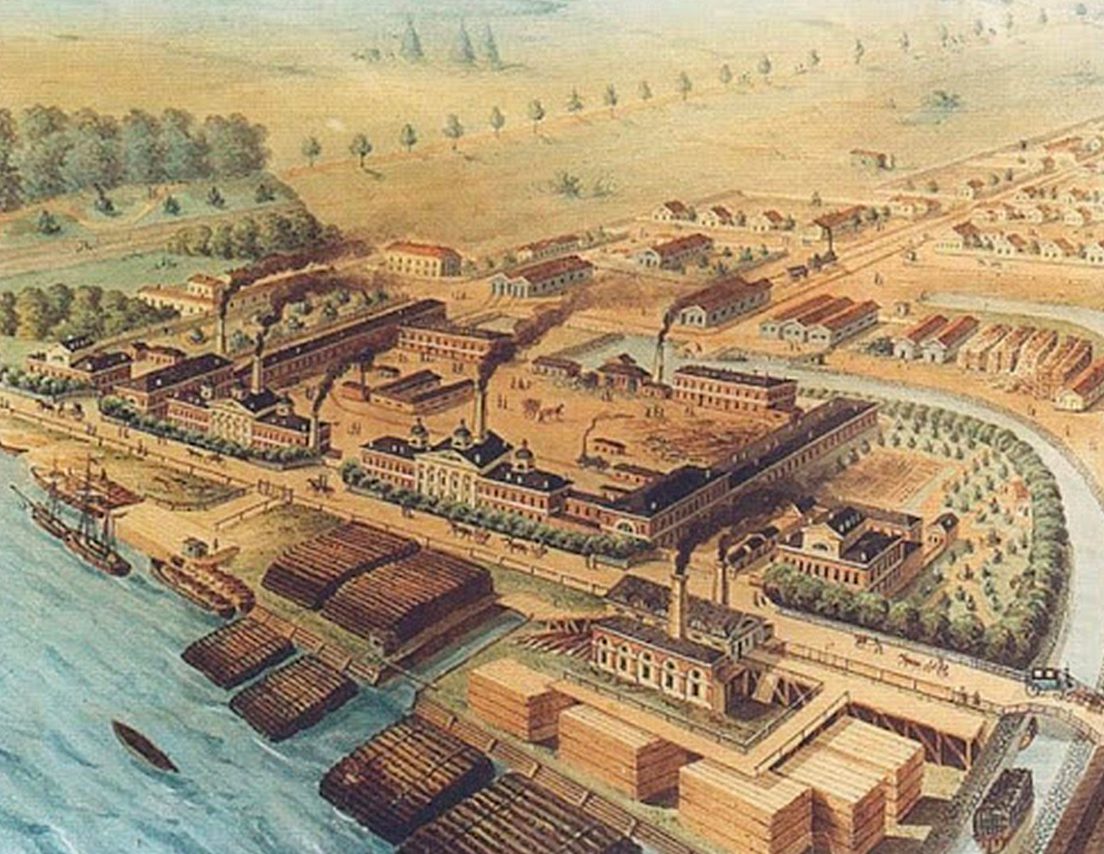 ALEXANDROVSKY (c.1840)
THE HOUSE WHERE WINANS WAS BORN FACES THE HIGHWAY FAR LEFT
THE WHISTLER CONNEXION
In 1843 the American company Harrison, Winans & Eastwick signed a $3-million, five-year contract to manufacture 162 locomotives, 2500 trucks and 17 miles of track. Its partners had been recommended by their compatriot George Washington Whistler, the railroad engineer appointed by Tsar Nicholas I to oversee the new line. Whistler arrived in St Petersburg in 1842, joined next year by his wife and children – including the future artist James Whistler, then aged 9, who would spend five formative years on the banks of the Neva. They lived in St Petersburg’s ‘English Quarter’ half-a-mile from the Winter Palace – home to a British-American Congregational Church, an English bank, the British and American Ambassadors, and ‘Madame Wilson’s Hotel’ on Galernaya Ulitsa. In Autumn 1844 the Whistlers moved to Quai des Anglais, opposite the Academy where young James studied art three times a week under Alexander Koritsky (1818-66). His tuition was in Russian and French.
James often went to play at Alexandrovsky with Andrew Eastwick’s son Edward, who was just one year older. In November 1847 James Whistler stayed with the Eastwicks for a whole week. Andrew Eastwick found him ‘too much inclined to play for a boy of his age’ – yet recognized his enormous potential: ‘He is a very clever boy and may be made of great service to the world.’
The Tsar had visited Alexandrovsky that March, arriving by train along the tracks laid from Nevsky Prospekt across the Whistler-designed Amerikansky Most (as it is still known); a spur 2½ miles later led directly into the Foundry, where 900 men worked a 13½-hour day. The Tsar was so impressed by the hive of activity that he gave all the Americans a diamond ring – and another bumper contract: to complete the cast iron Blagoveschensky Bridge across the Neva from Quai des Anglais to the Academy. This was the first permanent bridge in St Petersburg and, at 370 yards, the longest in the world.
George Washington Whistler died from cholera in April 1849, by when James had already left St Petersburg to pursue his studies in England. Walter Winans was not yet born – yet he and James Whistler would become related. Walter’s aunt Julia Winans married James’s half-brother George William Whistler; they lived at Alexandrovsky when Walter was a boy. In 1879 their daughter Neva Whistler (born St Petersburg 1860) would marry Walter’s cousin Ross Winans (born St Petersburg 1850) – at All Saints, Princes Gate, just south of Hyde Park (now, ironically, a Russian Orthodox Cathedral). The adult James Whistler met Walter Winans and found him ‘not a bad fellow.’
THE GREAT OLYMPIAN
Walter’s father William signed lucrative new contracts with tsardom in 1850 and 1865, remaining in St Petersburg (where he served as American Consul in 1854/5) until 1869, when he sold out to the Russian government for $24 million and retired to England. He settled in Brighton, at 1 Chichester Terrace on the new Kemp Town estate close to the beach, where his family had wintered since 1859. With an annual income of £2 million, William Wynans was deemed the richest man in the realm behind only the Rothschilds and Duke of Westminster. The family were waited on hand and foot by a retinue of 15 servants.
-

- ‘LITHE AND MUSCULAR’ WALTER WINANS IN VANITY FAIR (1893)

-
- WALTER WINANS SPORTING THE ORDER OF ST STANISLAUS

In 1881 Walter Winans married a local doctor’s daughter and moved down the street to 7 Chichester Terrace. In 1895 he decamped to Surrenden House near Ashford in Kent, infesting the grounds with deer, bison, moose, wild boar and antelope. The critters were seldom safe from Walter’s roaming rifle. He shot on an epic scale, stalking deer for days on end as far afield as Siberia (he was awarded the Imperial Russian Order of St Stanislaus).
In 1888 Winans was the hero of a large painting by Thomas Blinks entitled Walter Winans on the Running Deer Range, Wimbledon Common. It hung for many years in the Surrey Rifle Association clubhouse at Bisley Camp, before selling for £74,100 at Christie’s London in November 1997.
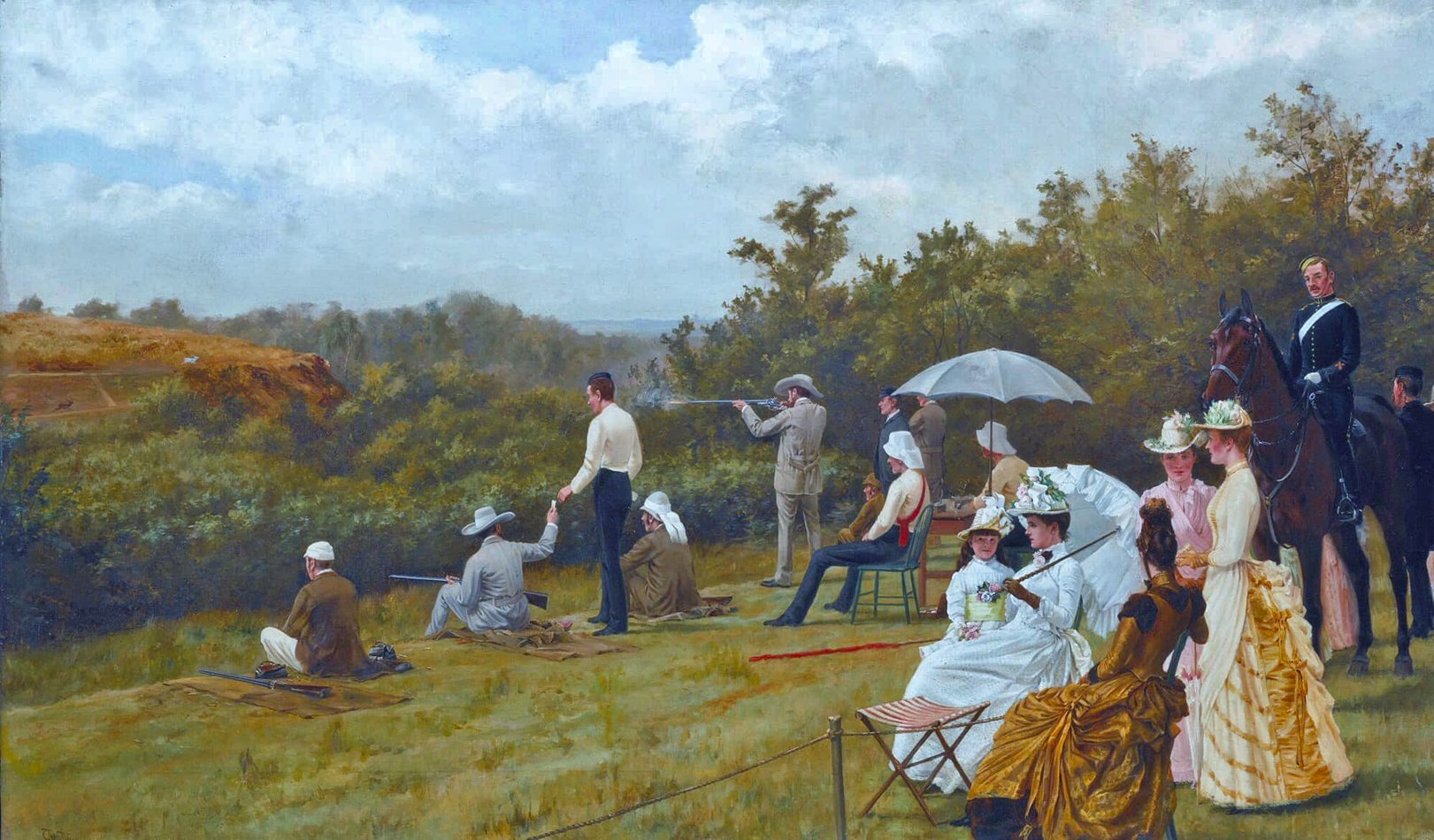 THOMAS BLINKS : WALTER WINANS ON THE RUNNING DEER RANGE – WIMBLEDON COMMON (1888)
Winans was Revolver Champion of England twelve years running and, in 1900, landed the Pistol Duelling title at the Exposition Universelle in Paris, where he liked to practise at the Gastinne-Renette indoor shooting gallery on the Champs-Elysées. He owned hunting estates stretching across Scotland from the Atlantic to the North Sea. He was Vice-President of the National Rifle Association of Great Britain. He could kill galloping stags at a distance of 200 yards, and is said to have shot more stags than any man alive. Be all that as it blood-curdlingly may, the Daily Express described him as ‘an amiable man, gentle of speech, clear of eye, wondrously steady of hand, spare, lithe and muscular’ with an ‘ever-smiling face.’
‘Never let the muzzle of any firearm point in the direction where it would do harm unintentionally, if discharged’ advised Walter in his 1919 book The Modern Pistol and How To Shoot It (possibly with Alec Baldwin in mind). ‘Only once in all my experience did I find a beginner who did not do this, and the beginner was a lady!’
Walter was referring to 16 year-old Londoner Helen Preece, whom he taught to handle a pistol while she was preparing to take part in the Modern Pentathlon at the 1912 Stockholm Olympics. Walter’s wisdom proved in vain: Pierre de Coubertin, founder and reactionary head of the Olympic movement, was so horrified at receiving ‘an application from a Neo-Amazon’ that he had females retroactively banned.
Unlike his thwarted protégée, Walter Winans did take part in the 1912 Olympics, lining up in the 50m Pistol at the age of sixty. He finished 49th – but consoled himself by captaining the U.S.A. to Team Silver in the Running-Deer Single-Shot, and by earning his second individual Gold Medal… for Sculpture, to become the first man to win Olympic Gold in both sport and art competitions (there would be only one more – Hungary’s Alfréd Hajós in 1924). Walter Winans remains the only man to land medals in Sport and Art at the same Olympics – making him arguably the Most Accomplished Olympian Of All Time.
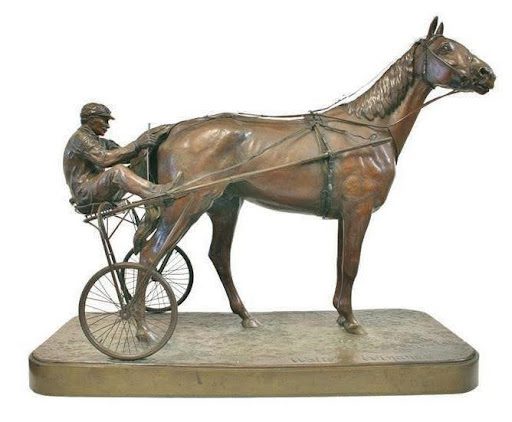 WALTER WINANS : AMERICAN TROTTER
(AWARDED GOLD MEDAL FOR SCULPTURE AT THE 1912 OLYMPICS)
Winans had creativity in his blood: he could trace his ancestry back to the 17th century Flemish artist Jan Wynants. His prowess as a sculptor had long been apparent – and retains saleroom appeal. His bronze Sioux Indian Chief on Horseback culled $30,000 at Hindman Auctions (Chicago) in 1994, while his ivory and bronze Mermaid, exhibited at the Royal Academy in 1909, fetched £62,500 at Christie’s London in 2016.
-
- MERMAID (1905)

-
- SIOUX INDIAN CHIEF ON HORSEBACK (1893)

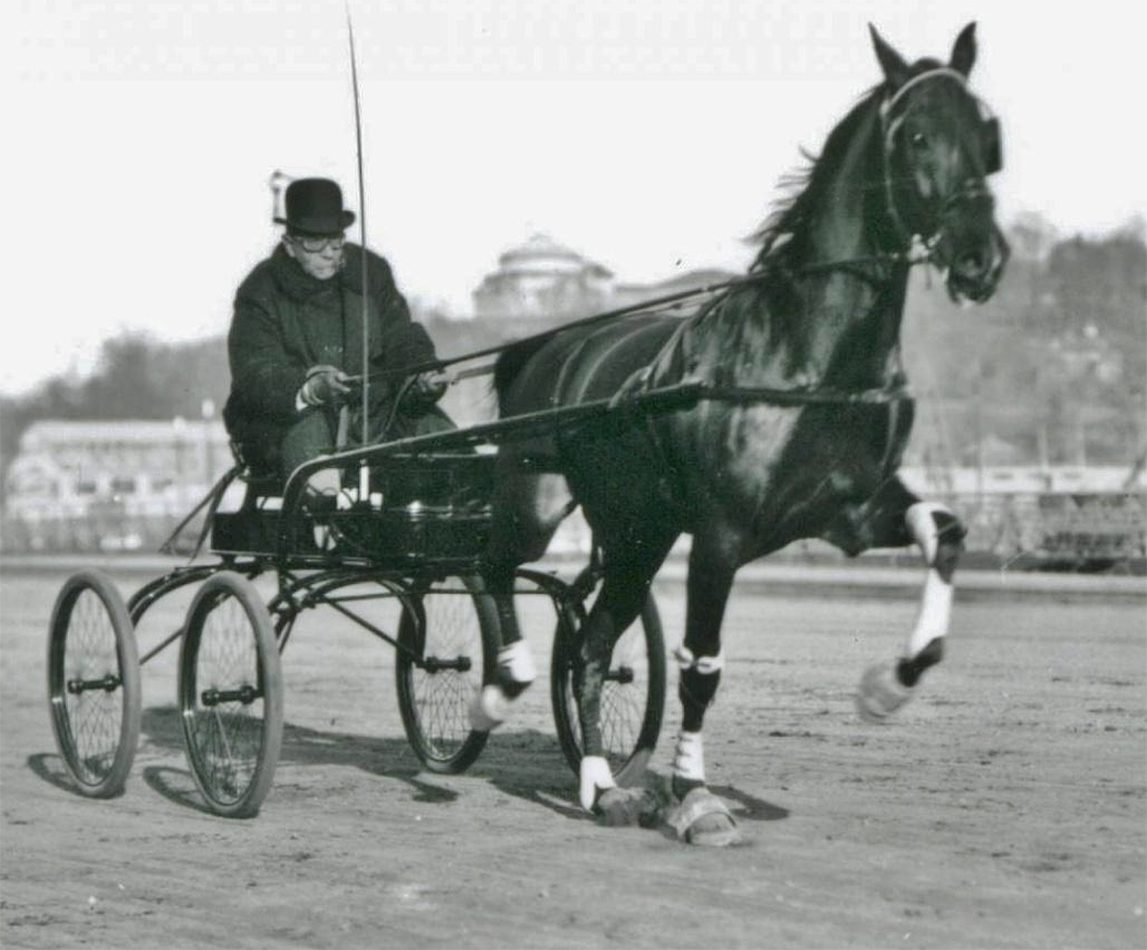
Walter Winans remained a Winner to the bitter end. On 12 August 1920 he had a heart attack while driving his sulky in a race at Parsloes Park in Essex. By the time his horse-and-carriage crossed the line, in first place, he was already dead.